When Gods Dance in Fire
My First Theyyam Shoot
It's been a while since I last sat down to write, and oddly, I find myself struggling to begin this one. It's not that there's nothing to say, but my first experience witnessing and documenting Theyyam feels almost too overwhelming to put into words. I remember the first time I stumbled upon Theyyam images on Instagram.
They didn't feel real. The colours, the expressions, the sheer intensity, it all looked otherworldly, like something pulled out of mythology rather than reality. Around the same time, the visuals from the movie 'Kantara' stayed with me. That raw, fiery energy sparked something deeper, and before I knew it, I was quietly obsessed with experiencing it myself. It took me two years to finally act on that feeling. I decided to pause everything; work, shoots, the usual chaos and give myself a week to travel to the Malabar region in Kerala, where Theyyam comes alive between November and March. This time, I did something I usually don't. I booked a guided experience with Theyyam Tours. I tend to treat first visits like a solo recce, figuring things out on my own. But this felt different. It wasn't just a place I was visiting; it was a culture I didn't fully understand yet. And I wanted to do it right! The base was 'Thalassery', a town with its own quiet legacy. Known as the birthplace of cake-making in India, where cricket first took root during the British era, and even home to the origins of the Indian circus, it felt like a place layered with stories.
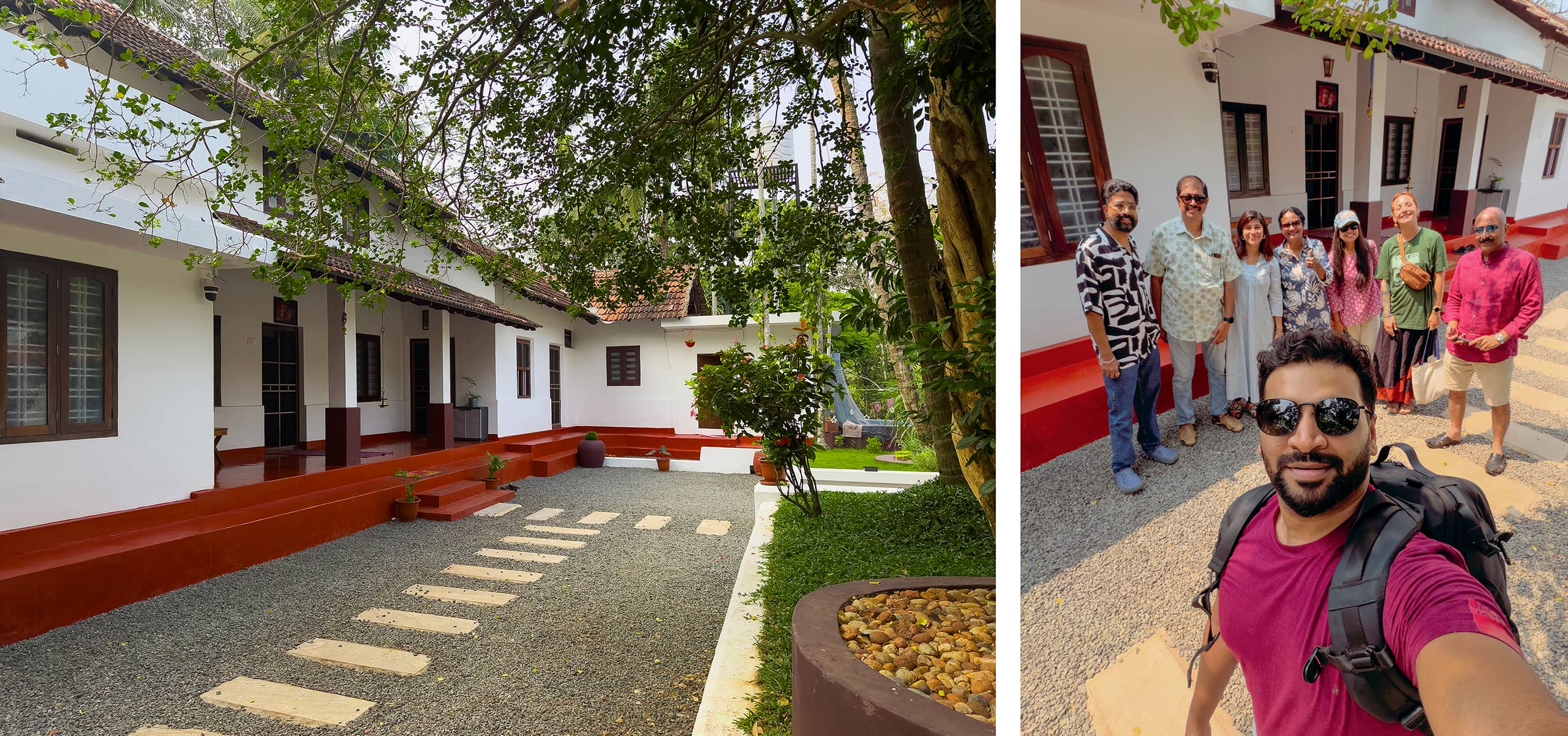
I reached early in the morning, slightly tired but curious. Found a simple, decent-looking restaurant to start the day. Before anything else, they served me a glass of warm pink water- 'Pathimukam'. It's made by boiling shavings of a special wood and is a common Ayurvedic drink here. Subtle, earthy, unfamiliar, yet comforting in its own way. After a satisfying breakfast of soft appams and spicy lentils, I made my way to the homestay arranged by the tour. That's where the journey really began with a warm welcome, a quiet sense of anticipation, and the feeling that I was about to witness something far beyond just a visual spectacle.
Briefing on the Theyyam Background
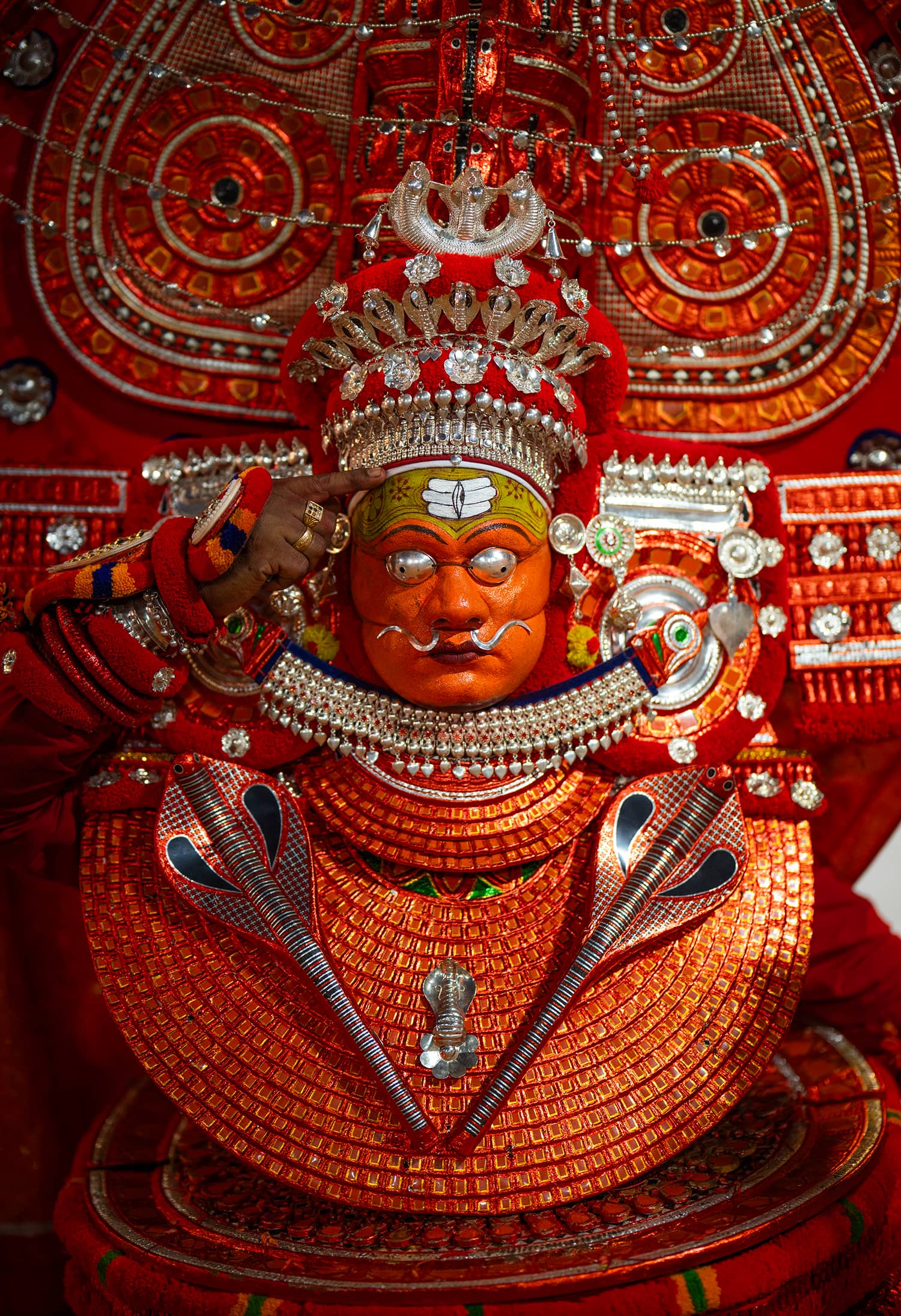
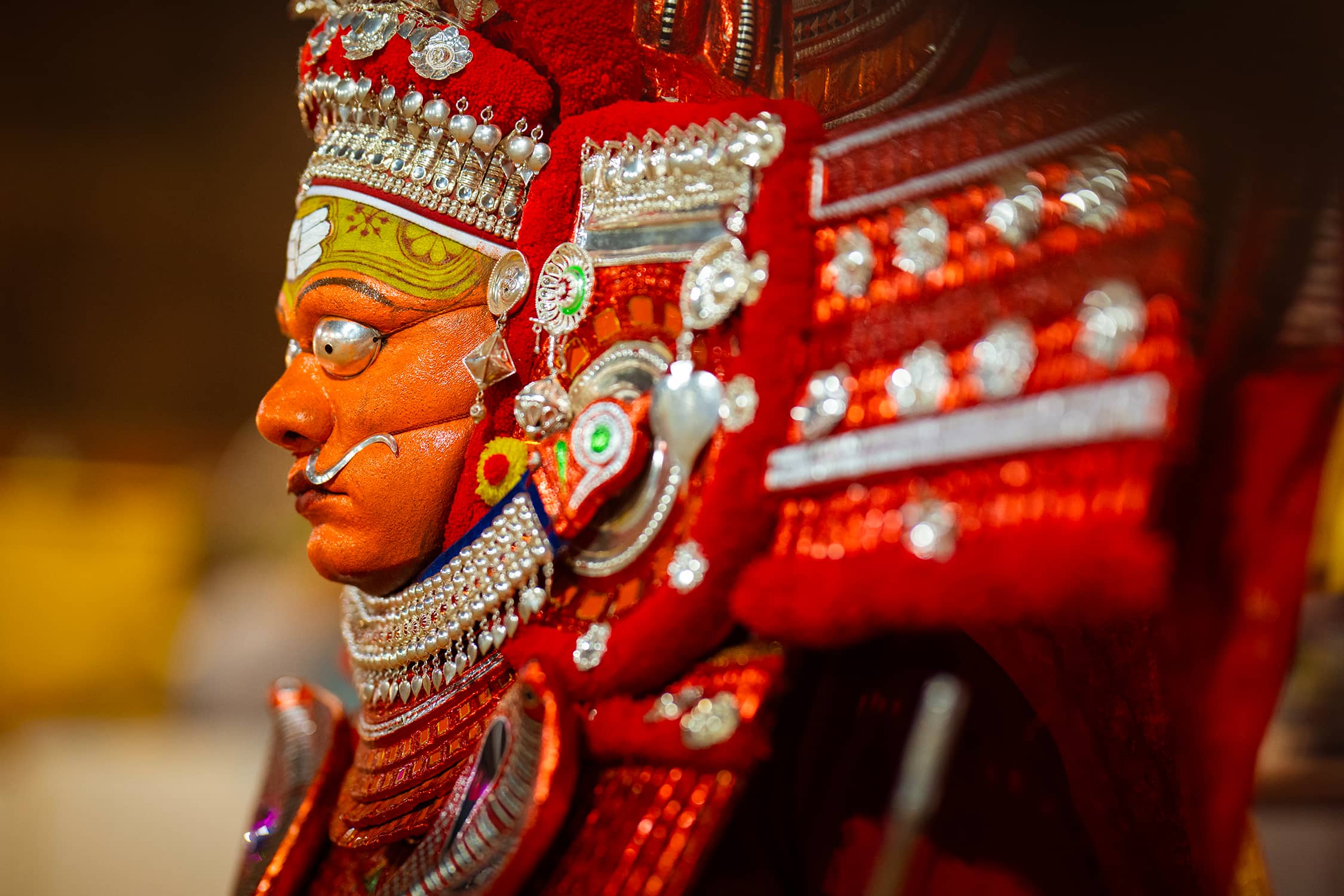
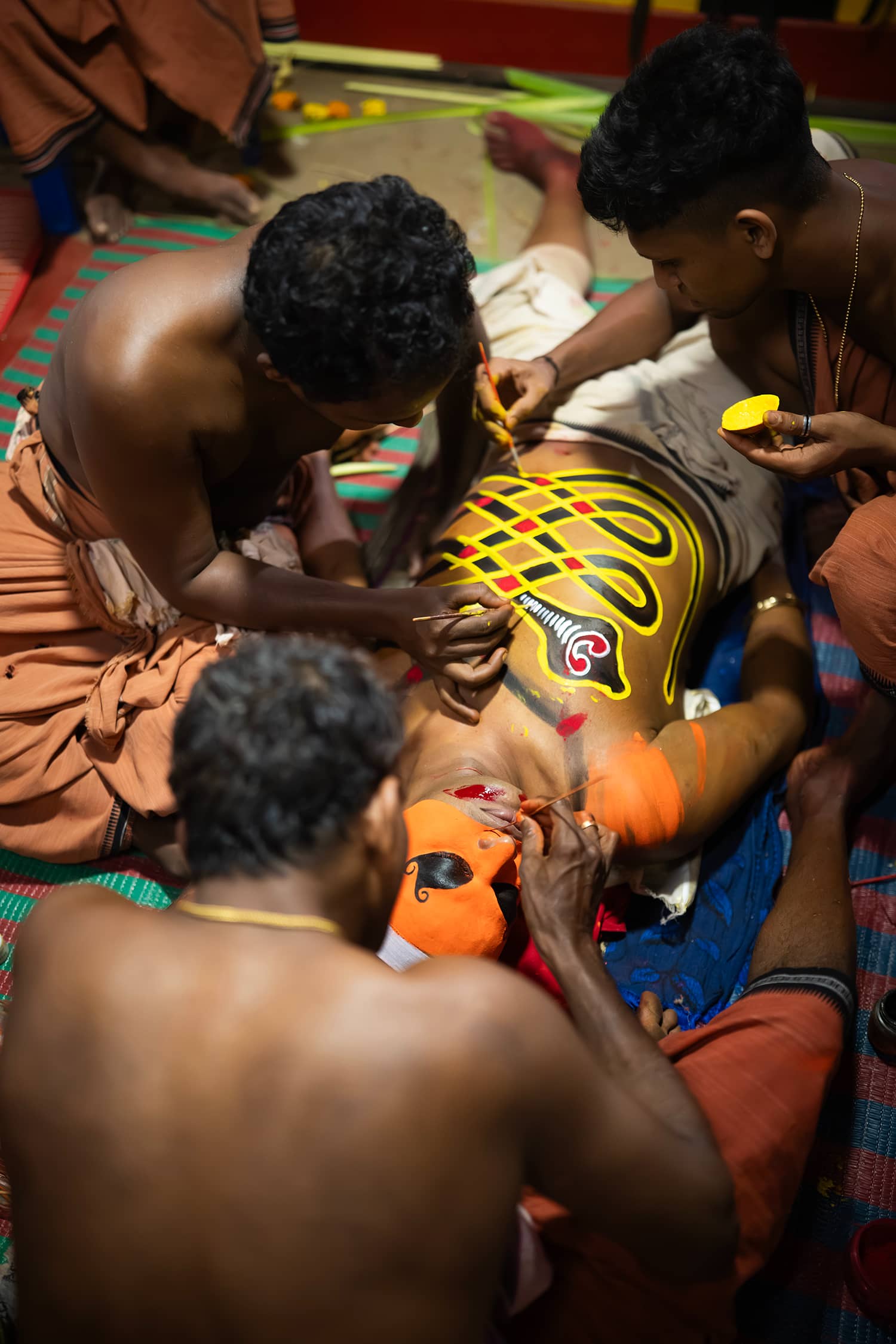
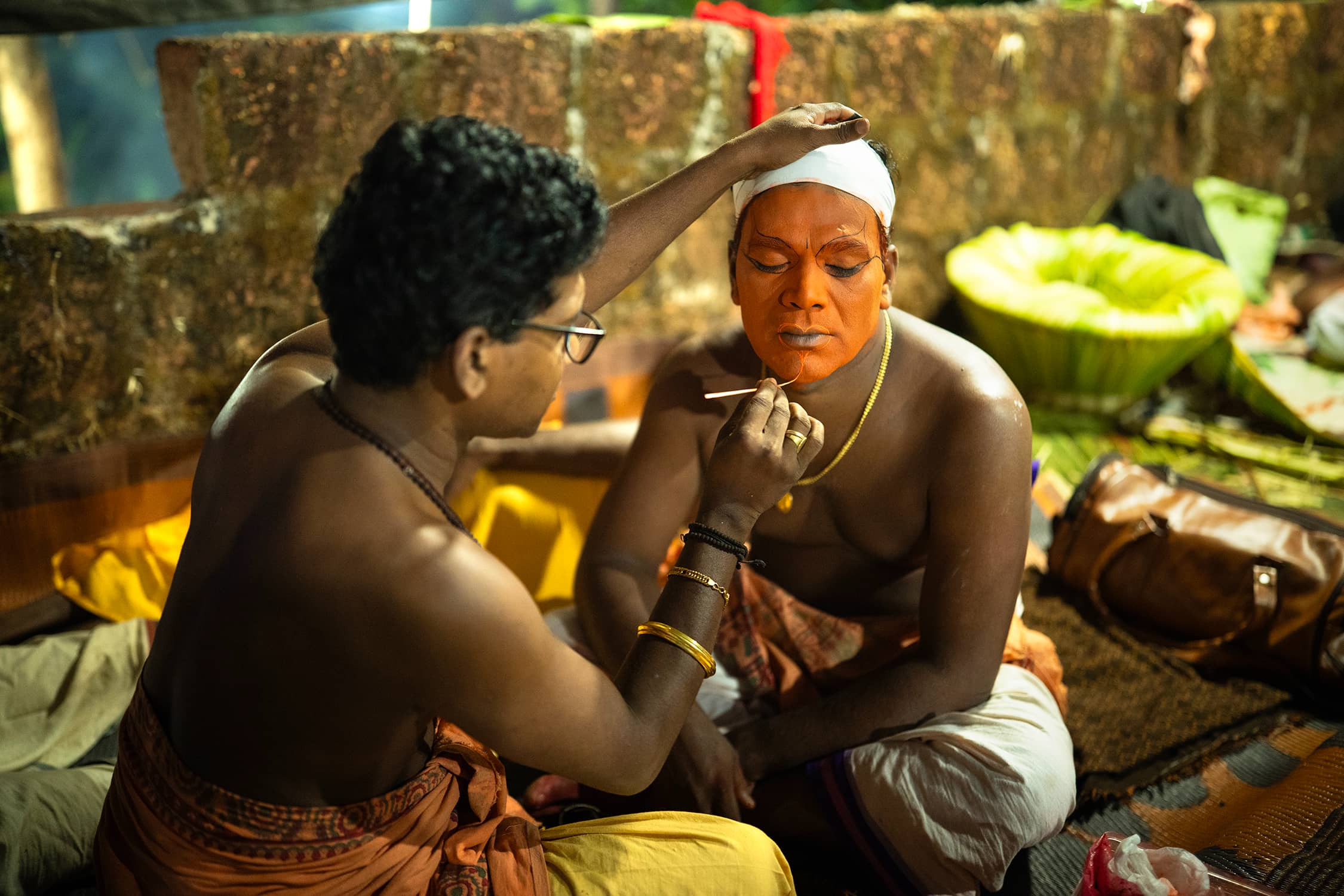
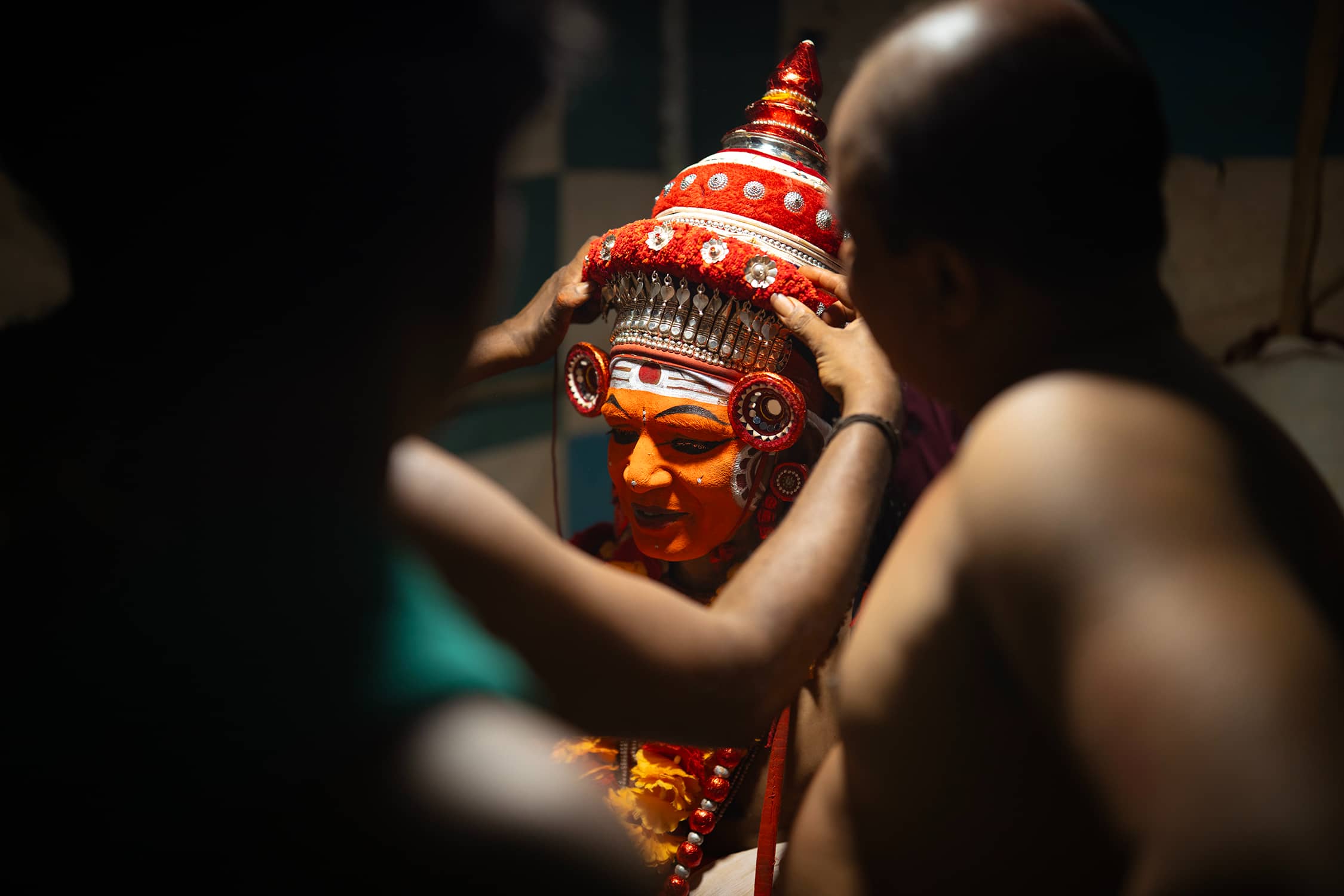
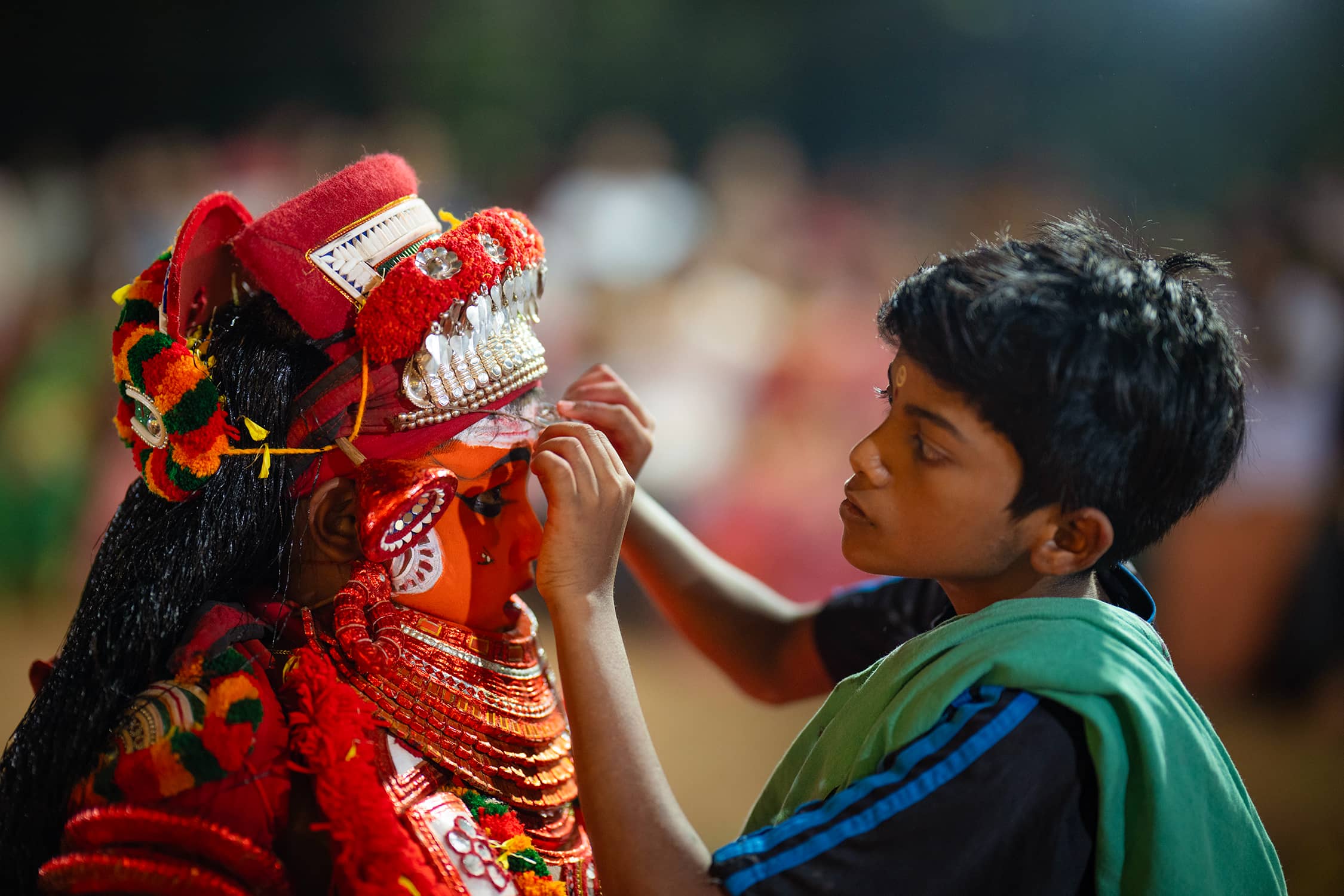
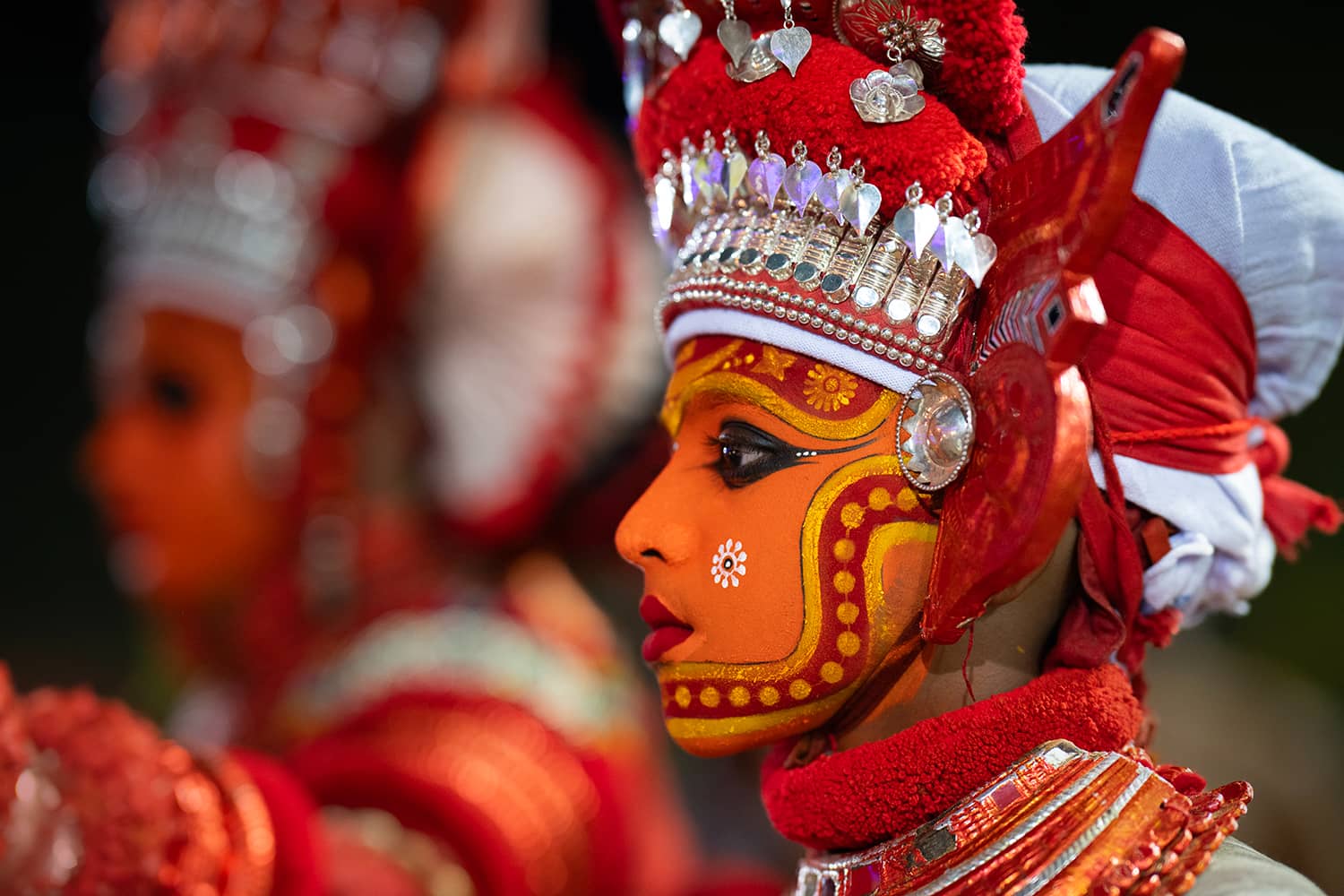
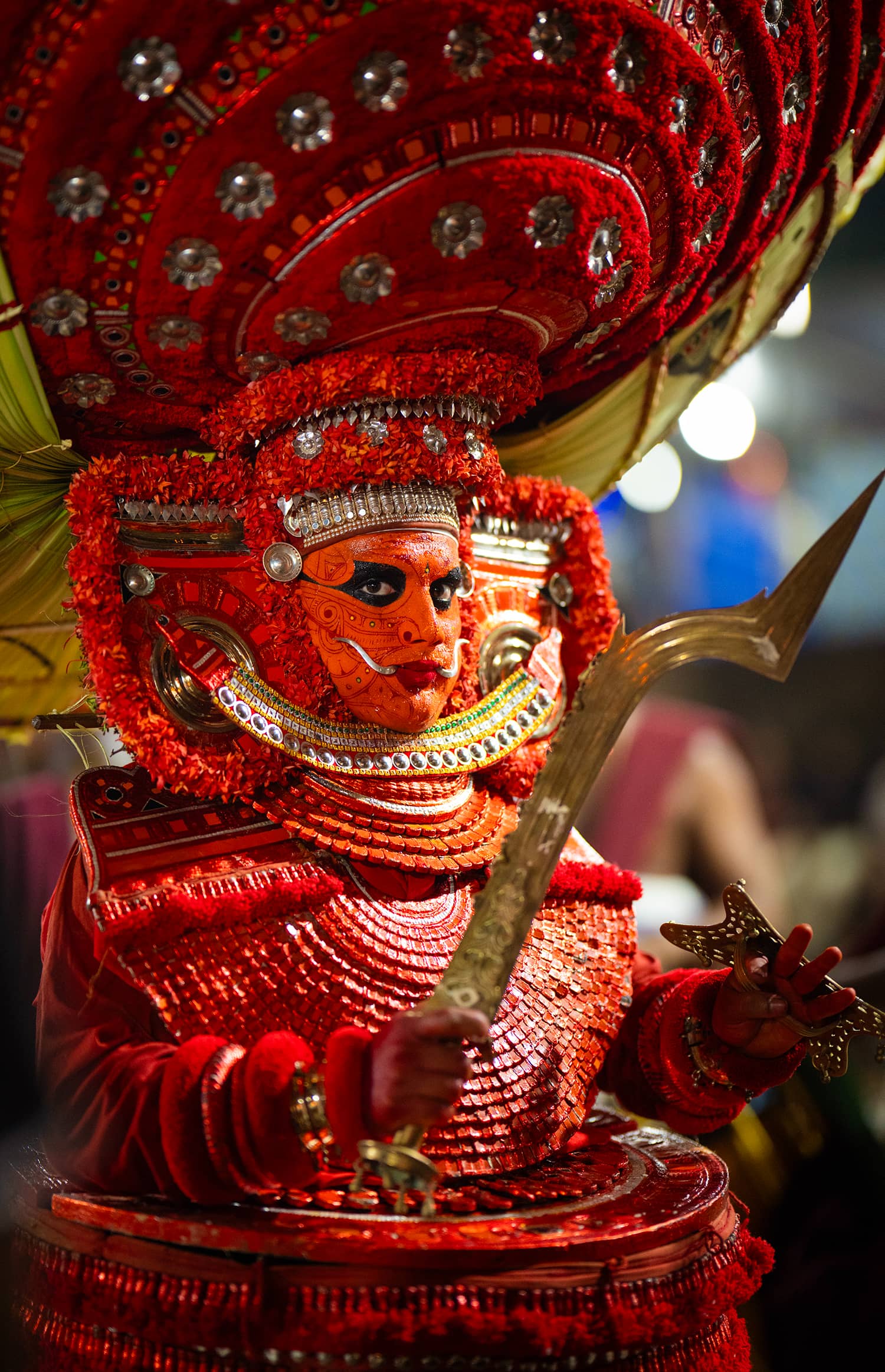
I wasn't alone on this journey. Seven others were in the group- strangers, but all bound by the same curiosity. Each of us was about to witness our very first Theyyam. A quiet excitement mixed with uncertainty filled the air; we all knew something intense was coming but didn't quite know what to expect. Before we headed out, our guide gathered us and walked us through the world we were about to step into, its history, its significance, and even the unspoken rules for photographing it. What to do, what to avoid, when to shoot, and more importantly, when to simply put the camera down and observe. He spoke about how Theyyam, deeply rooted in the northern parts of Kerala, especially Kannur and Kasaragod- is more than just a performance. It's a living ritual. A transformation. A moment where the line between human and divine begins to blur. Theyyam isn't just one form; there are around 400 to 456 different types, and about 112 of them are especially well-known. Each one stands out with its own unique costumes, detailed face makeup, and a distinct style of performance. The more he explained, the more I realised how layered it all was. Hours of preparation, intricate face painting, elaborate costumes, and behind-the-scenes rituals all lead up to that one moment when the performer steps out, no longer as himself, but as the deity. And from that point on, he is treated as one, blessing people, listening to their prayers, and becoming a bridge between worlds.
What stayed with me even before witnessing it was the intensity he described: the fire, the trance-like movements, and the relentless rhythm of drums cutting through the night. Each Theyyam, he said, carries a story. Of Gods, of spirits, of ancestors. Stories that have lived on through generations. Interestingly, despite my own fixation on capturing the dramatic fire rituals and high-energy performances, our first visit was to a temple that hosted Theyyam in daylight. These were quieter, more rooted in the everyday life of the village, often performed in the ancestral homes of communities like Thiyya, Nambiar, and Vaniyar. It felt like a gentle introduction. Almost as if the ritual was easing us in, before revealing its more intense, untamed side.
Seeing Theyyam for the First Time
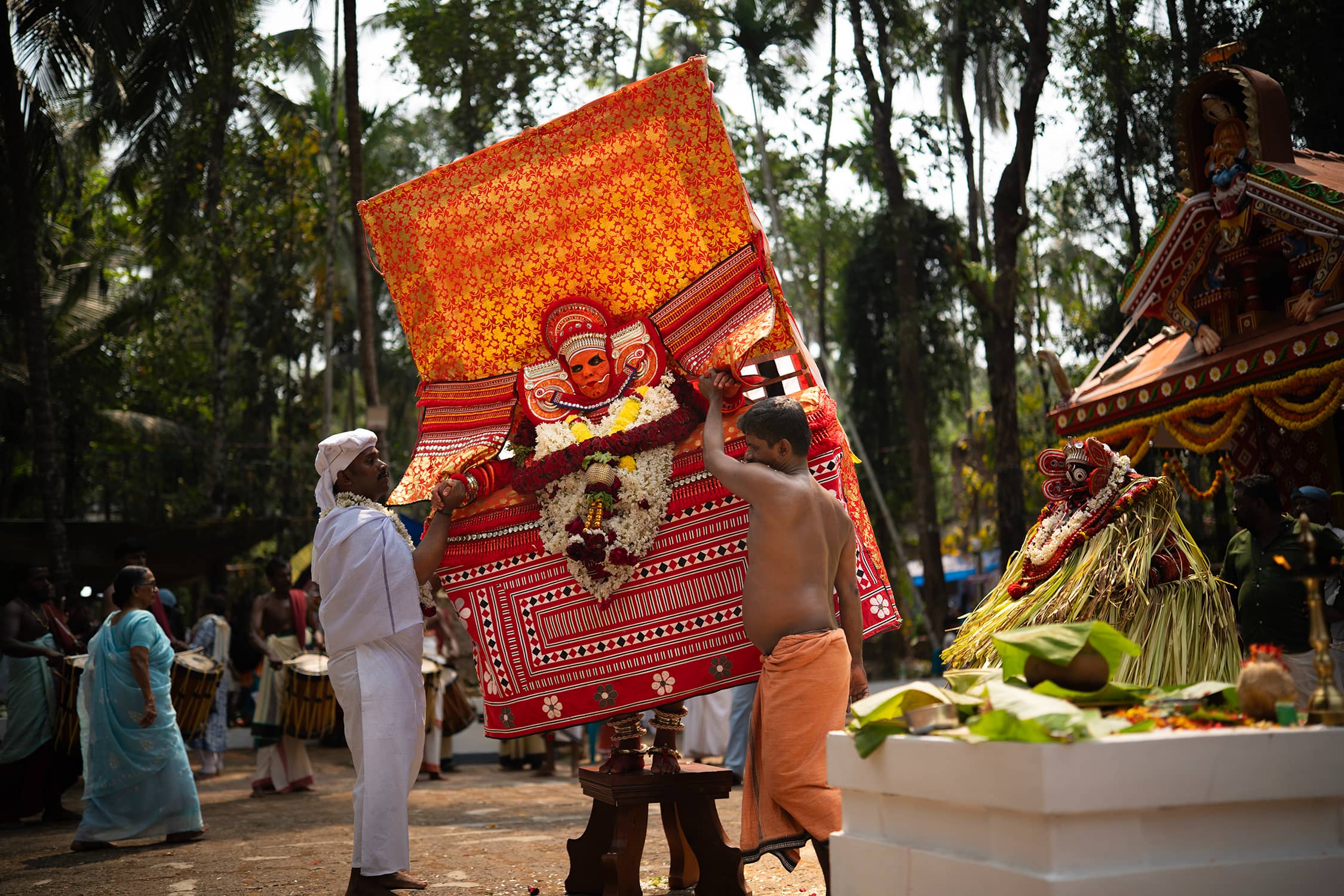
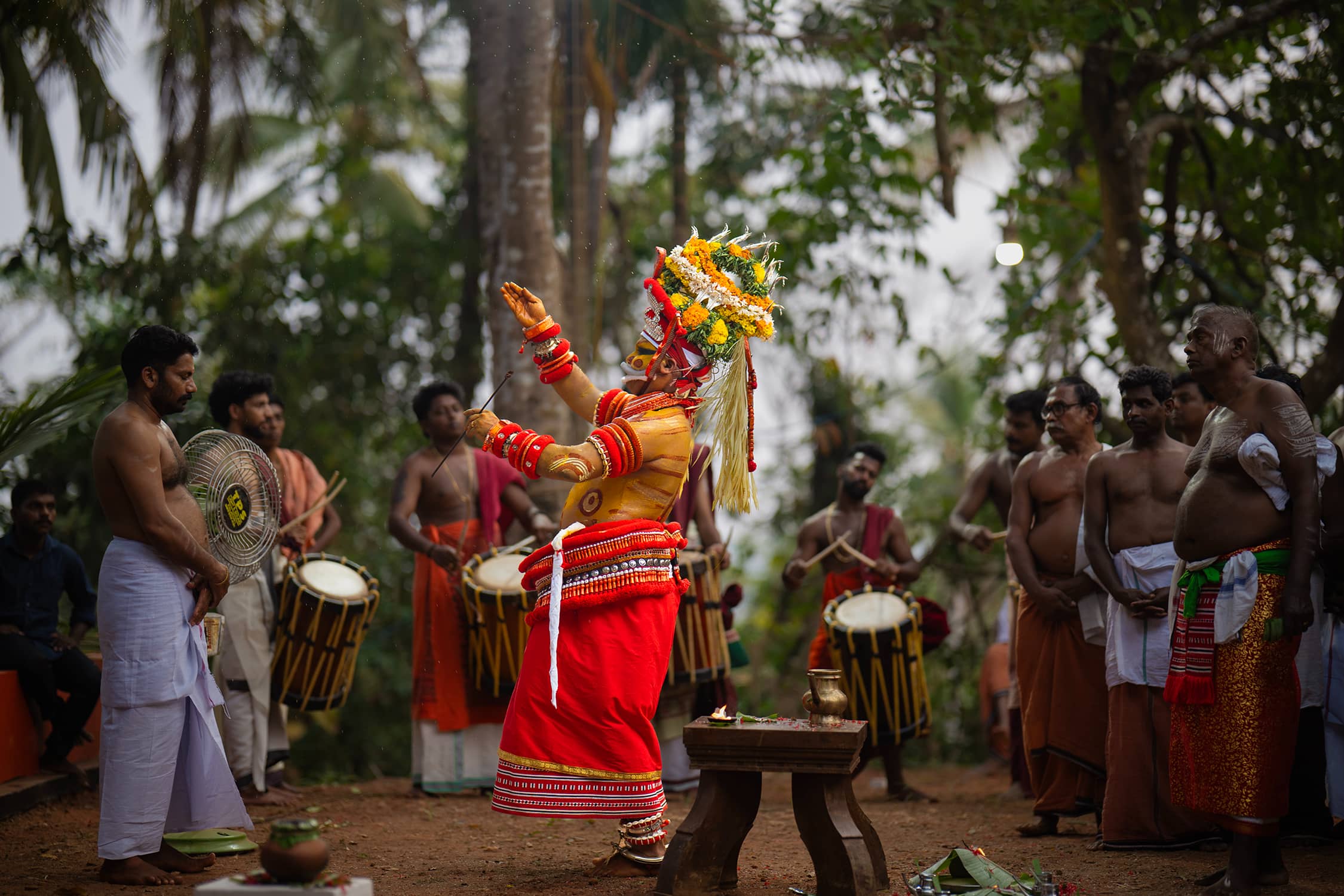
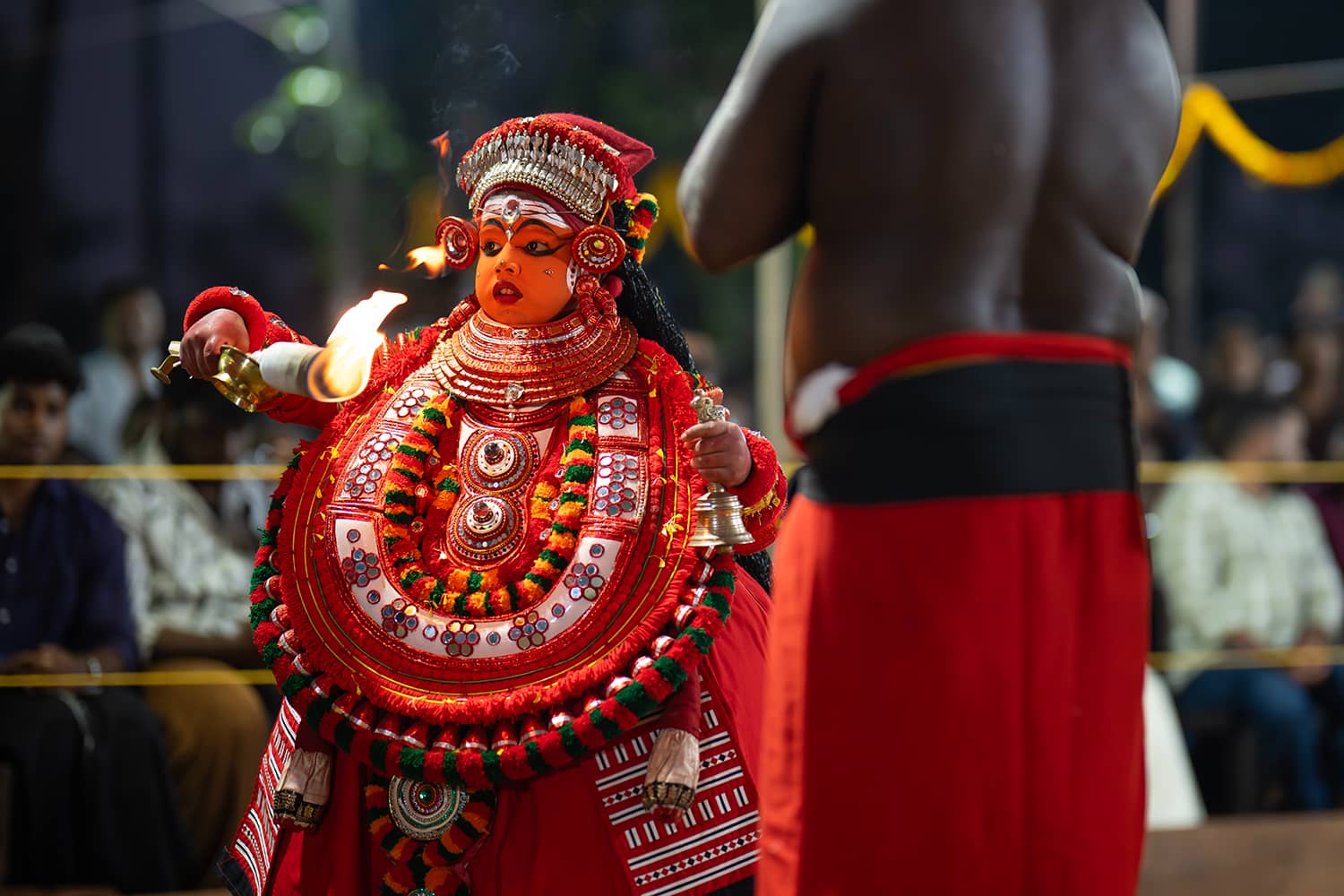
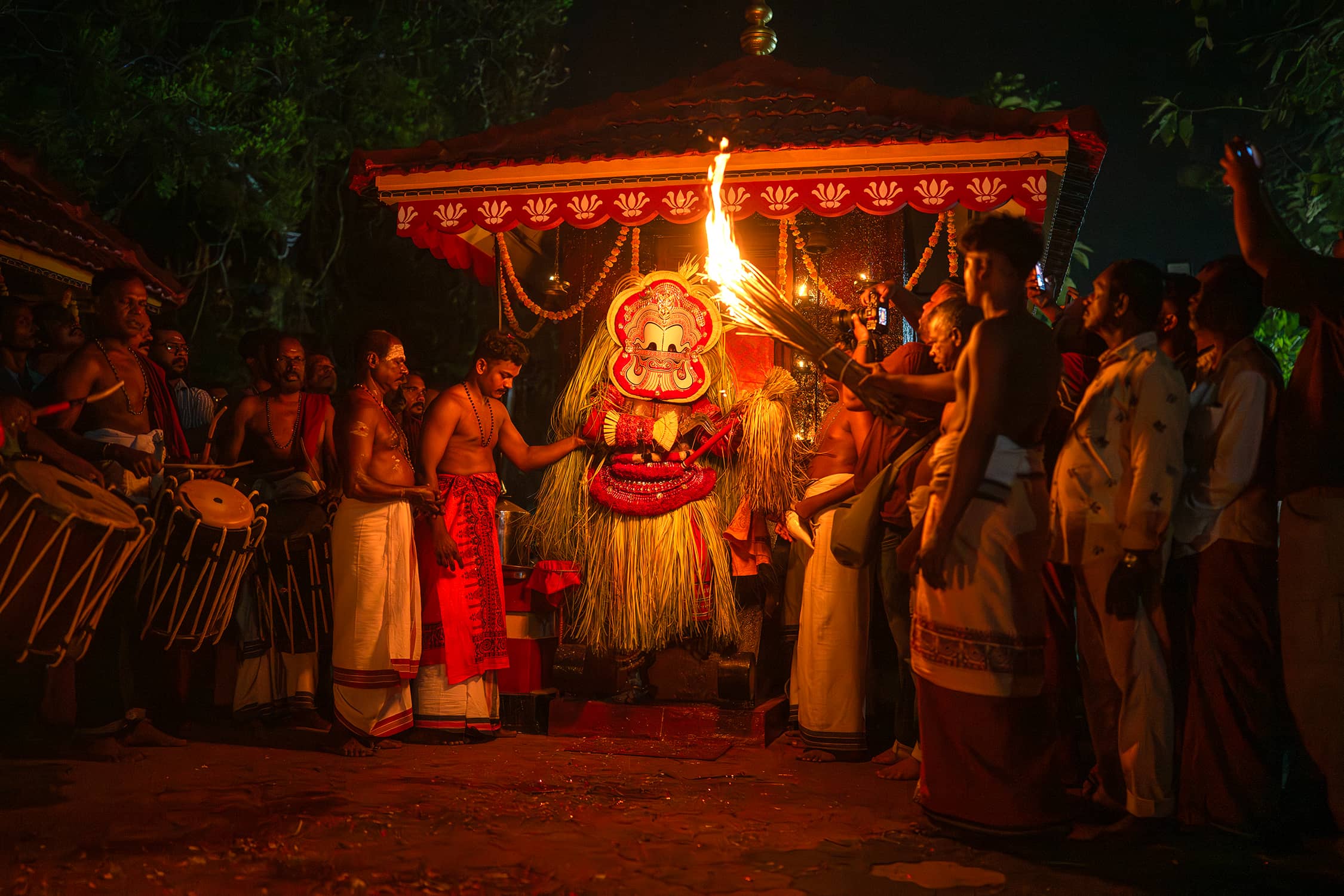
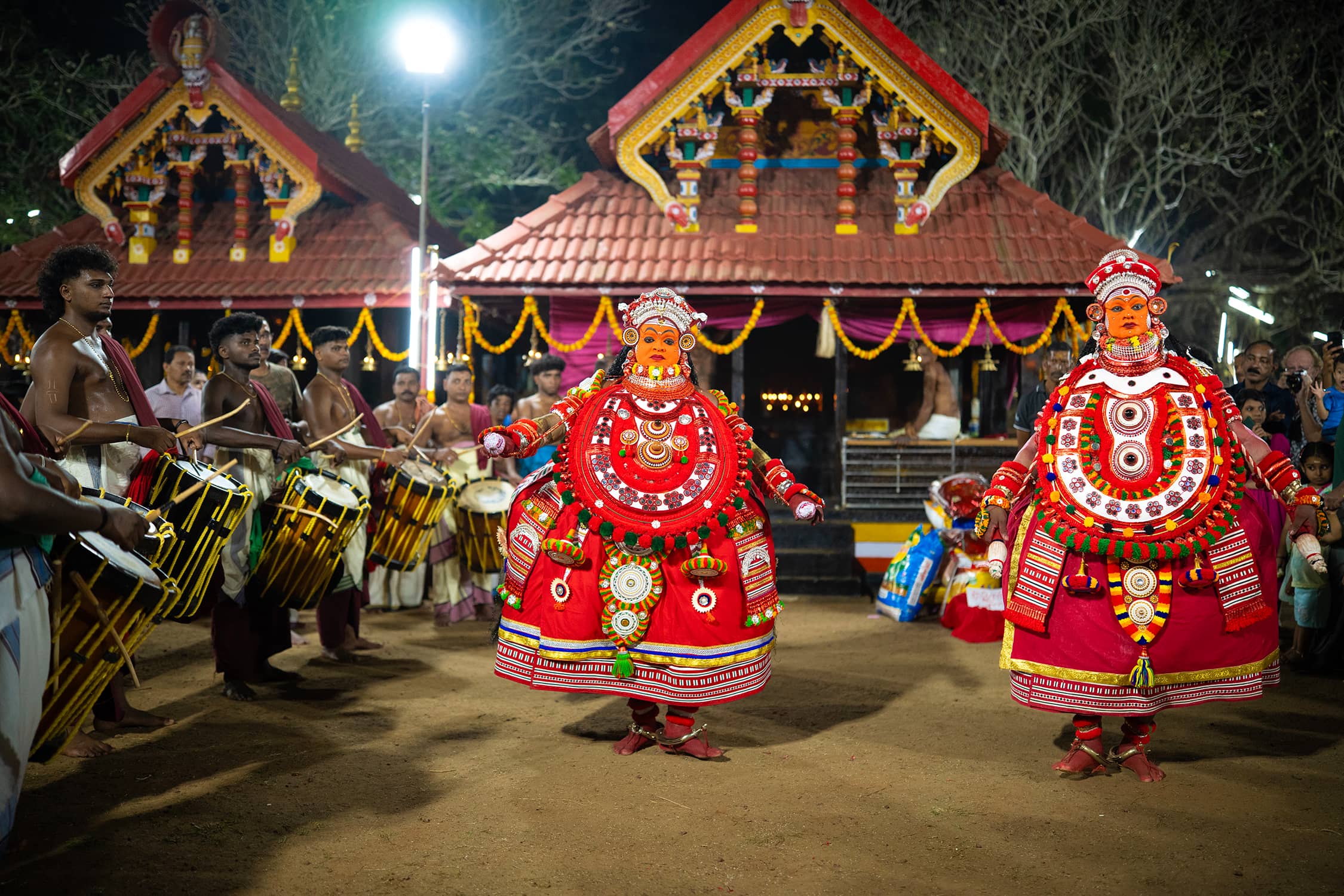
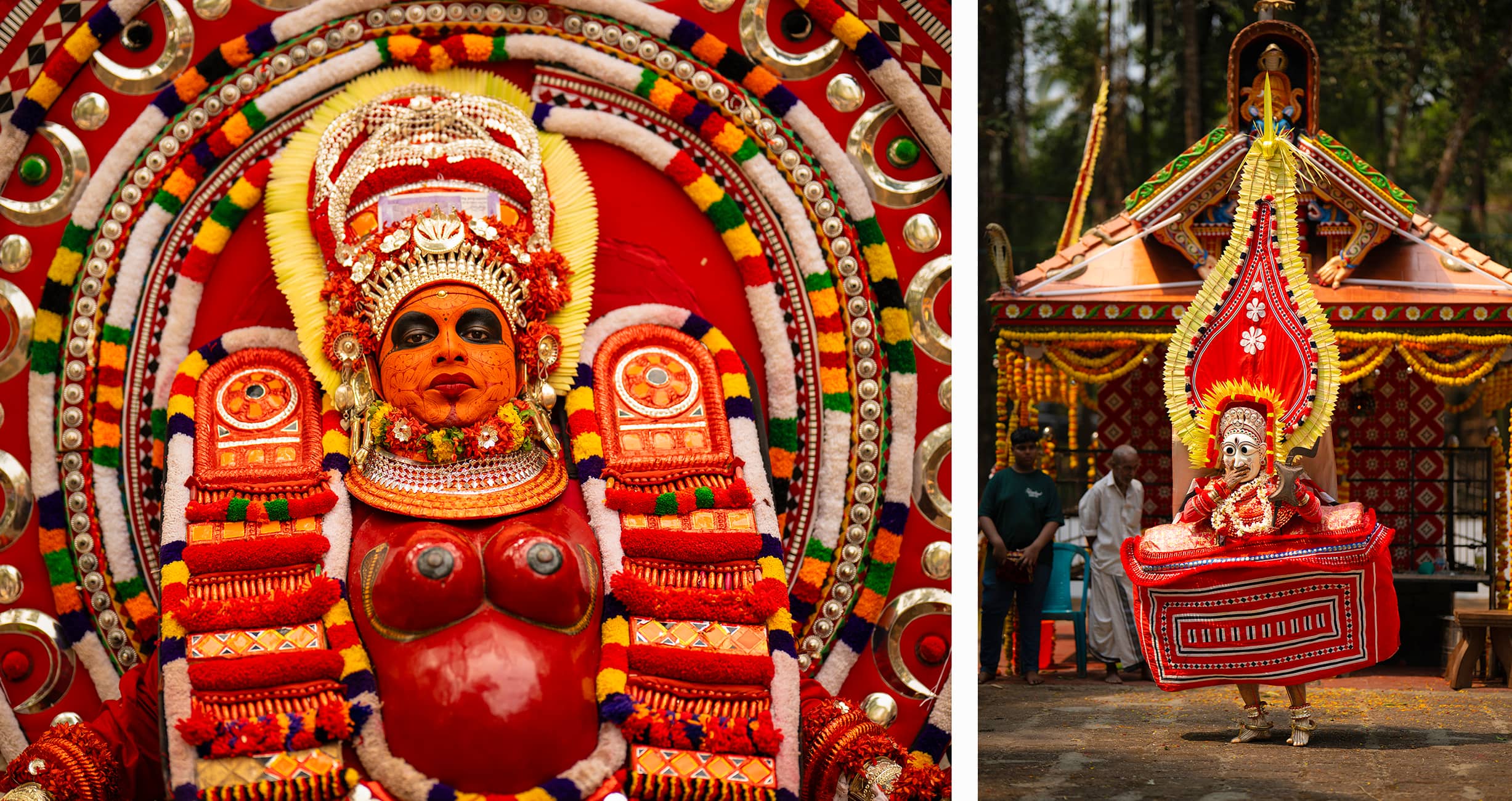
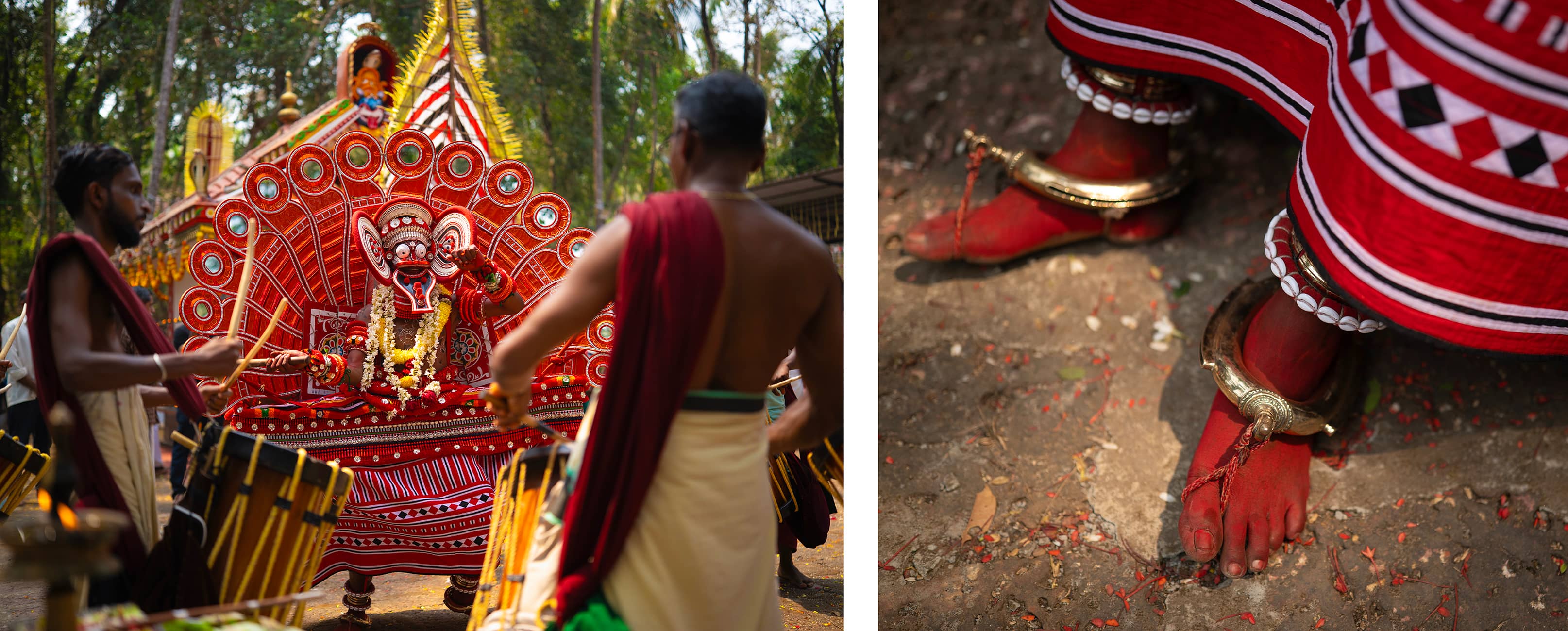
Within half an hour, we had left the city's chaos far behind. The shift was almost instant. As we approached the location, the first thing that hit me was the sound of drums- deep, rhythmic, and impossible to ignore. It felt like they were calling you in. Colorful flags fluttered overhead, and a large crowd had already gathered around a small temple that seemed to sit quietly at the center of it all. Theyyam performers were already there, seated on low traditional stools, fully adorned with incredibly detailed face paint and larger-than-life costumes. People approached them with folded hands, seeking blessings, and a quiet reverence filled the air despite the growing energy. As the drums grew louder, something shifted. The performances began.
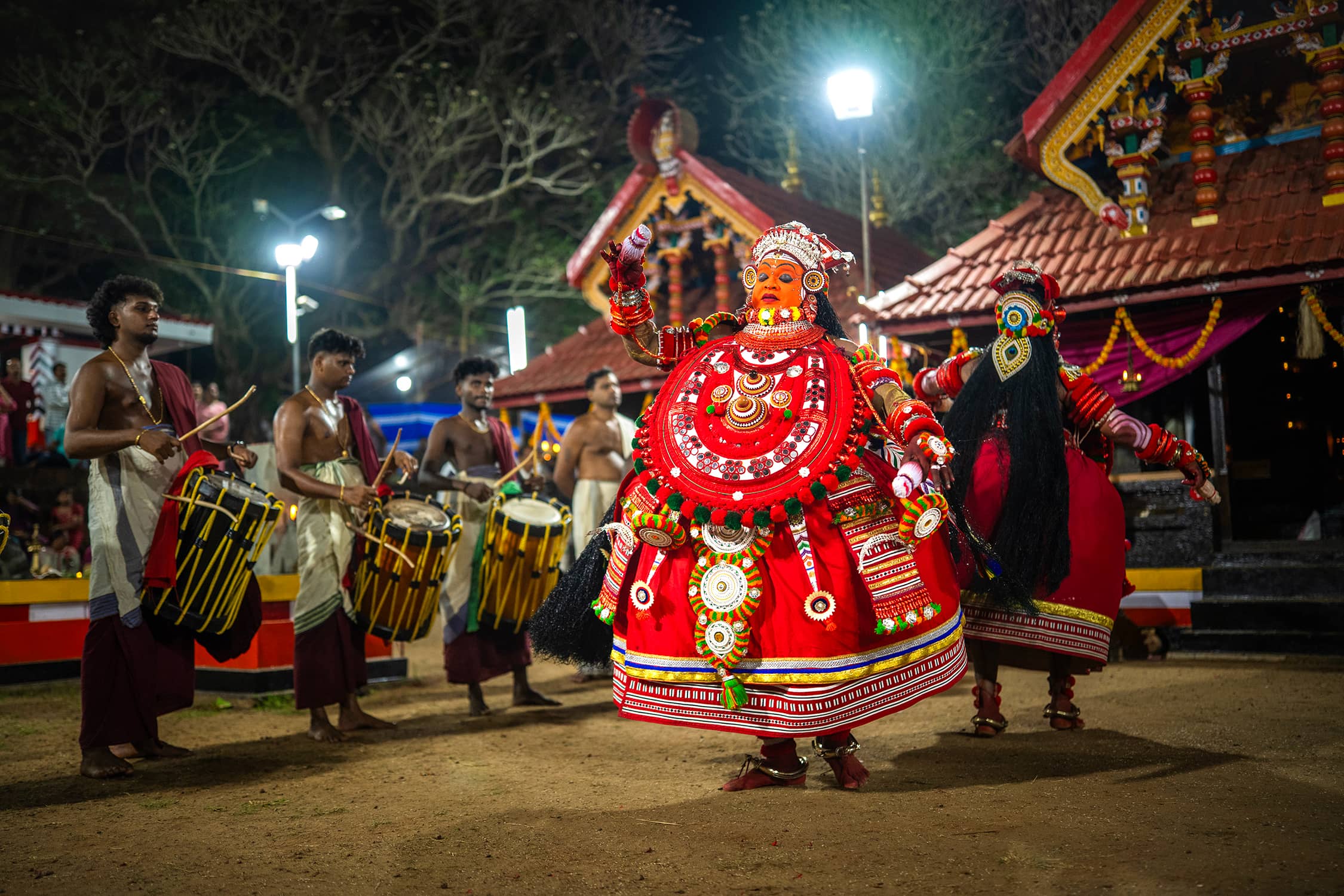
It started with offerings and greetings to the deities inside the temple and nearby shrines. And then, slowly, the movement began. The performer stepped into rhythm, almost cautiously at first, but with every beat, the energy built. The dance became faster, more intense, and more consuming. It didn't feel like someone performing anymore, it felt like something taking over. I remember just standing there, completely still, soaking it all in. It felt divine, almost surreal. In that moment, I was so immersed that I genuinely forgot I had my camera with me! And then, almost suddenly, more performers entered the scene. What started as one became three, maybe four, each in their own space, yet somehow connected through the same pulsating rhythm of the drums. Everywhere I looked, there was movement, colour, energy. It was overwhelmingly positive. It felt like a visual overload, yet it was also deeply grounding. And somewhere in between trying to take it all in and finally remembering to pick up my camera, I realised how lucky I was, not just to document this, but to simply be there, witnessing something so raw, so powerful, and so alive.
Theyyam Costumes
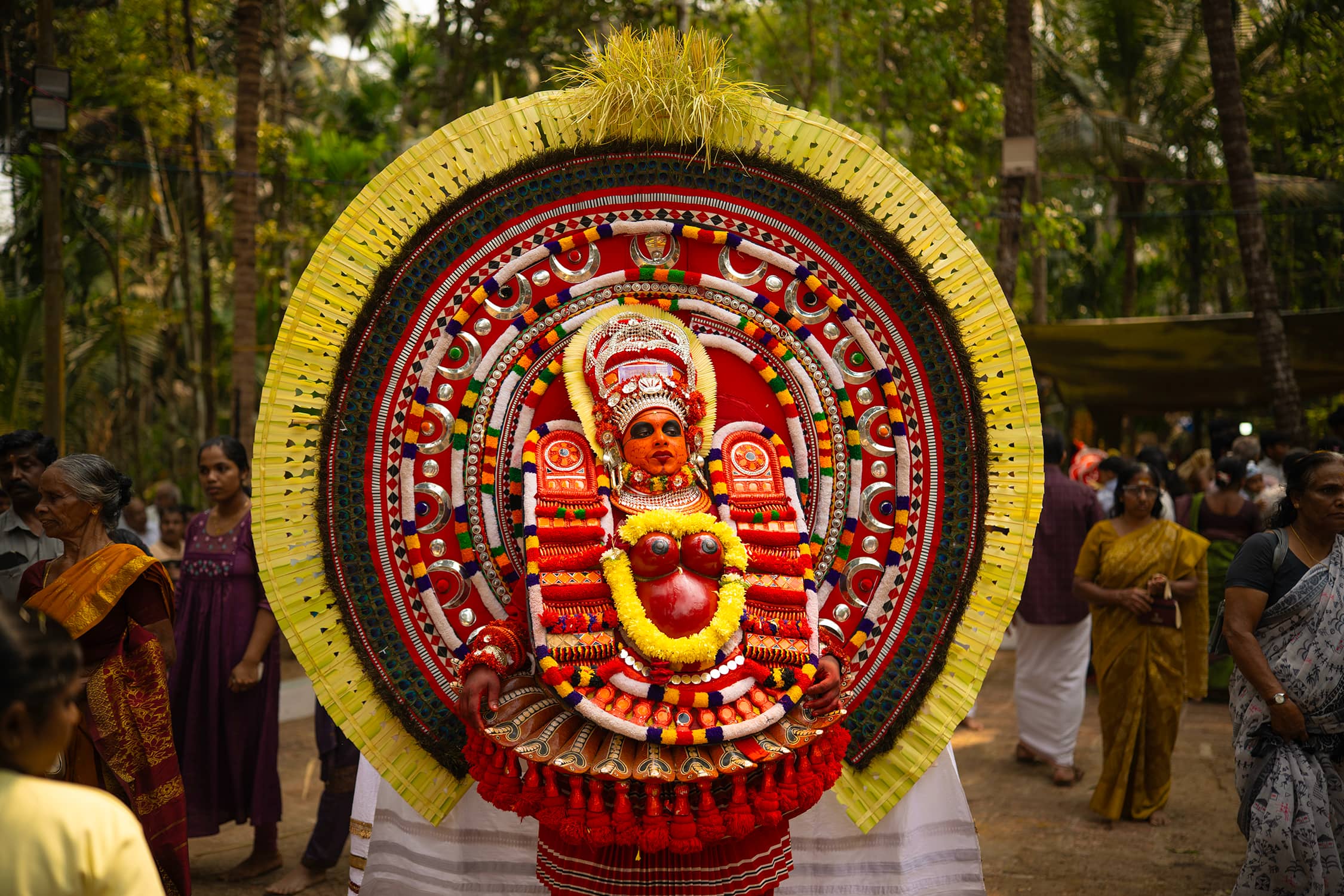
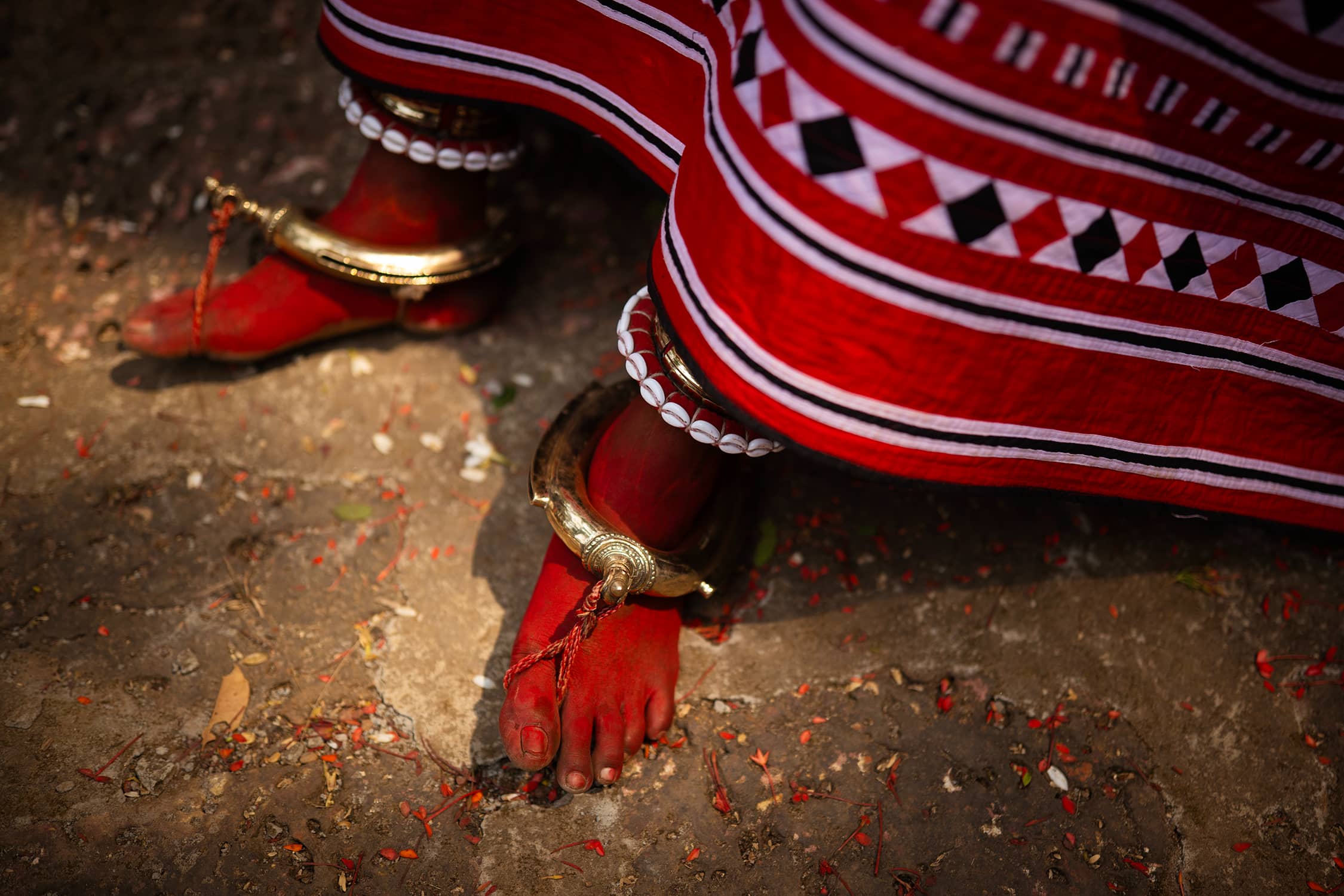
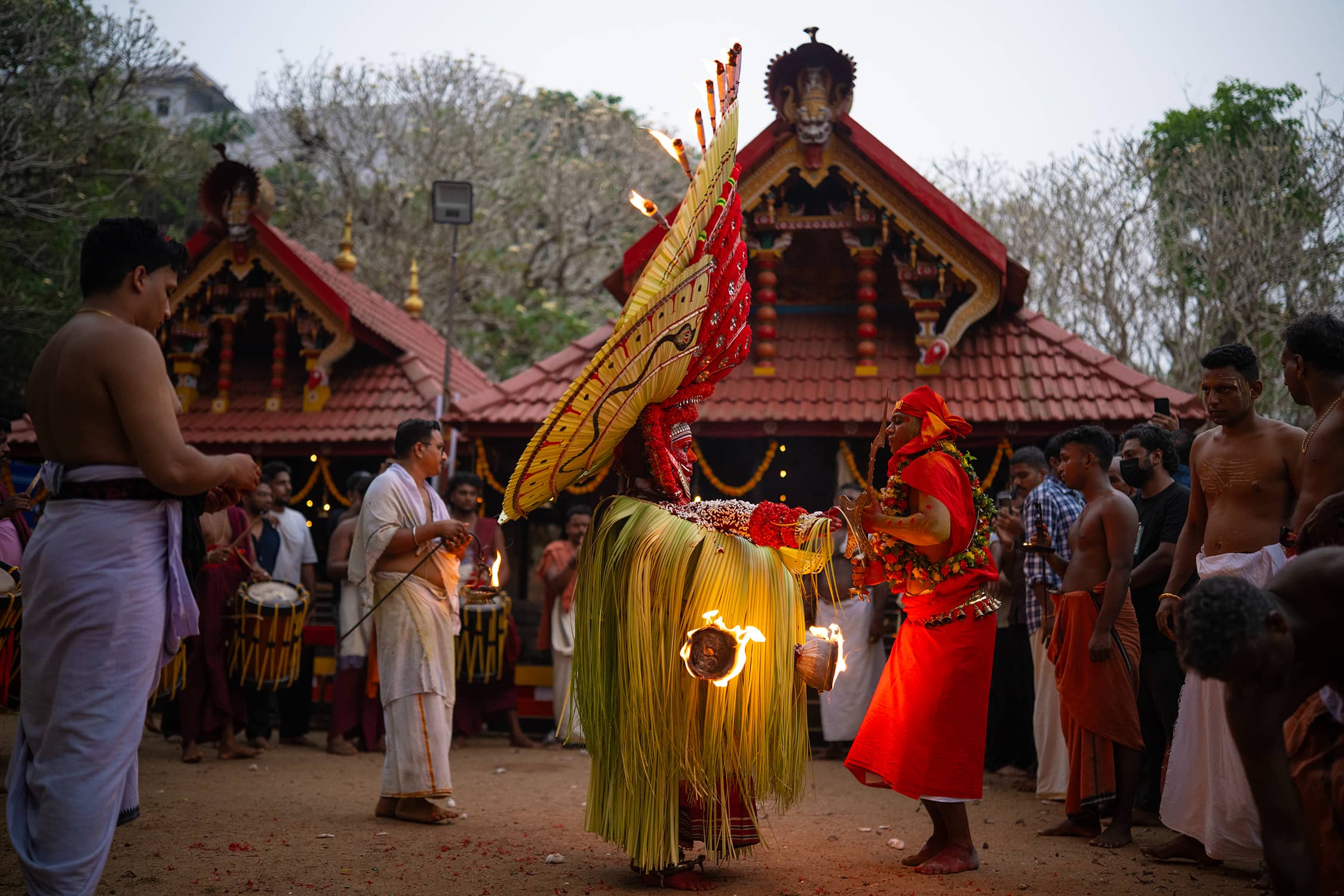
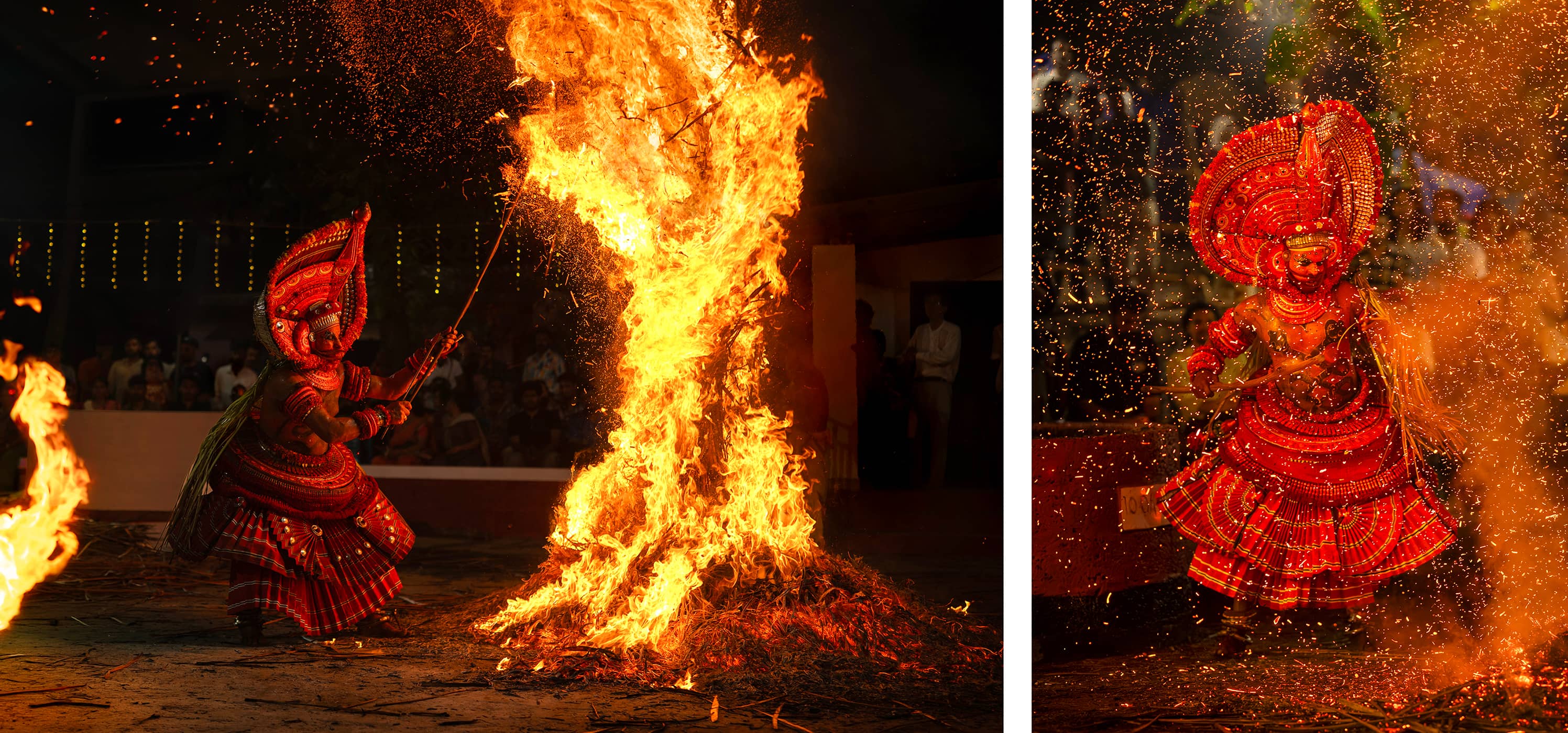
One of Theyyam's most fascinating aspects is how deeply it is rooted in nature and the costumes made using coconut leaves are a perfect reflection of that. These costumes are crafted from fresh coconut fronds, carefully split, trimmed, and woven by hand. The leaves are often used to create layered skirts, flowing extensions, and sometimes even parts of the arm or back adornments. When worn, they form a dense, textured silhouette that feels both raw and alive. What makes them truly special is their movement. As the performer dances, spinning, stamping, or moving through fire, the coconut leaves rustle, sway, and flare out dramatically. There's a certain wildness to it. Unlike heavier, more rigid costume elements, these leaves respond instantly to every motion, amplifying the energy of the performance. Visually, the bright green of the fresh leaves contrasts beautifully with the bold reds, blacks, and whites of the face paint and other costume details. But beyond aesthetics, they carry meaning, symbolising a connection to the earth, impermanence, and tradition. Since the leaves dry out and decay quickly, these costumes are often made fresh for each performance, which adds to the ritualistic purity of the act. Standing there and watching it up close, you don't just see a costume — you see something organic, almost breathing, becoming one with the performer as the ritual unfolds.

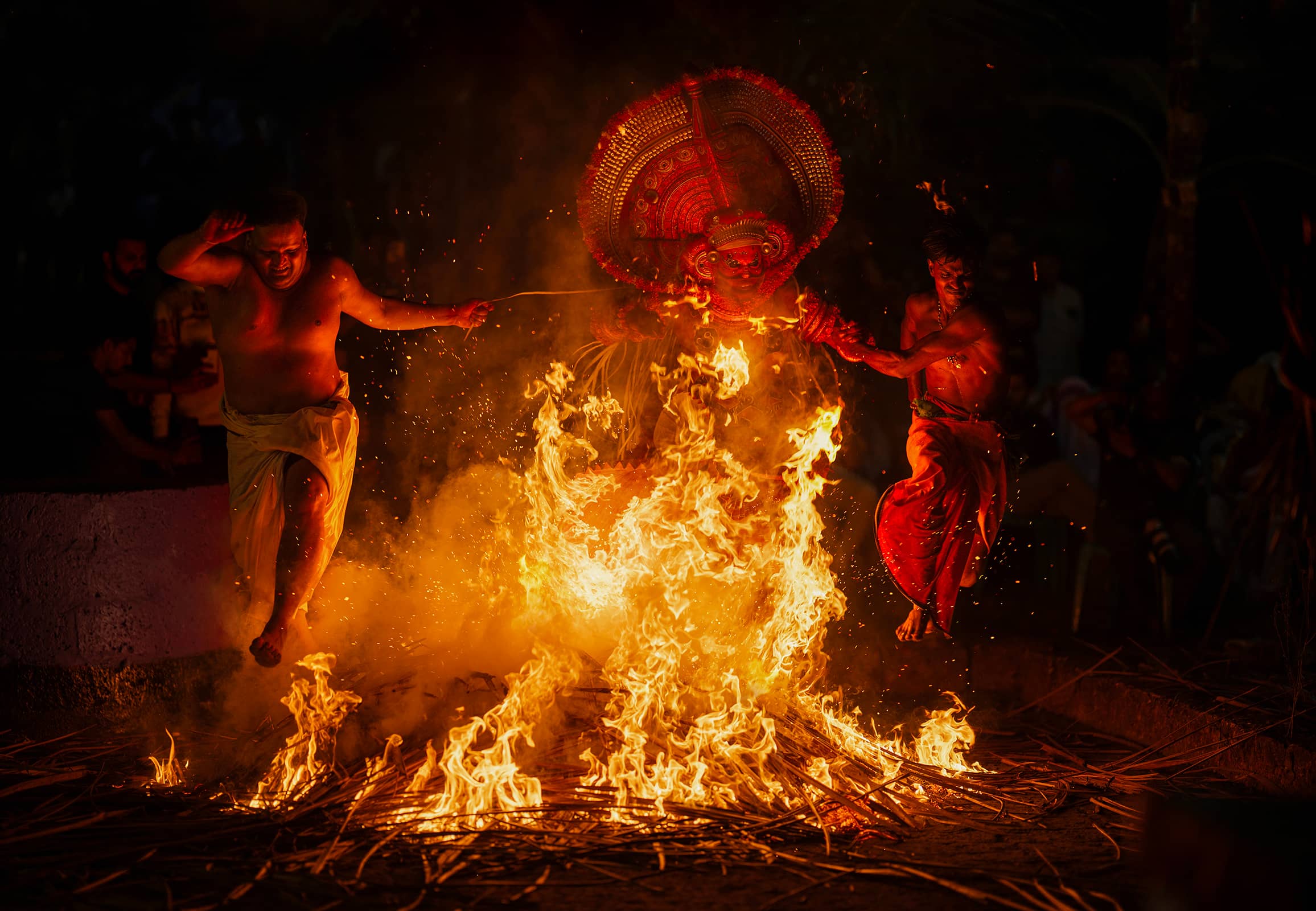
The Fire Theyyam - Kandanar Kelan
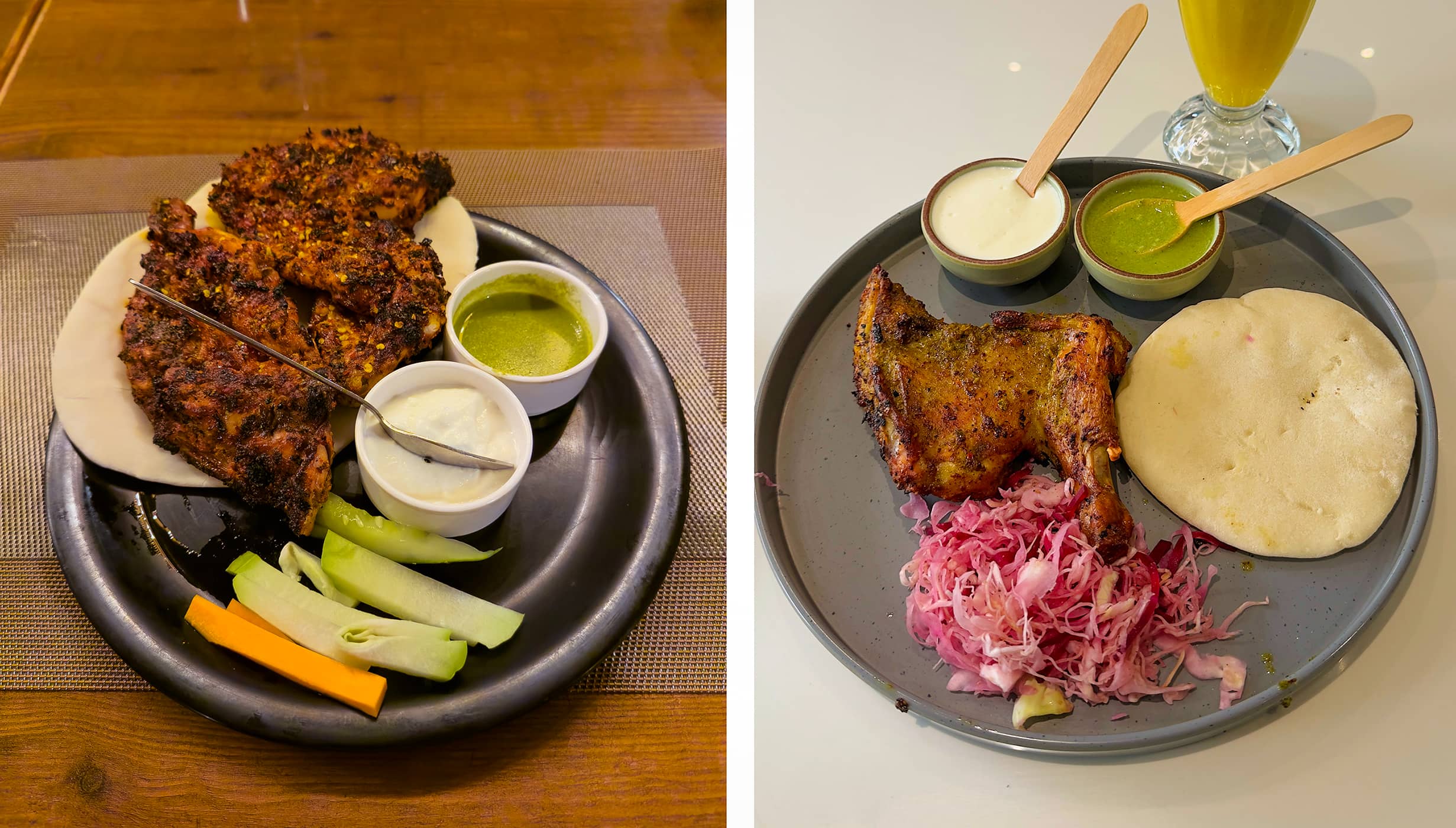
We got back to the base by late evening, slightly exhausted but still riding the high of everything we had seen. Dinner turned out to be a highlight in itself. On Ola's suggestion (my co-traveller), I tried Chicken Alfam, and that was it. I was hooked! It's a beautifully roasted chicken, served with pita bread, garlic sauce, and a simple salad. There's something very comforting about it, almost Lebanese in spirit, like it's just missing a side of hummus to complete the picture. But honestly, it didn't need anything else. The peri peri seasoning was bold, spicy, and exactly how I like it. Safe to say, I ended up having Chicken Alfam every single day after that.
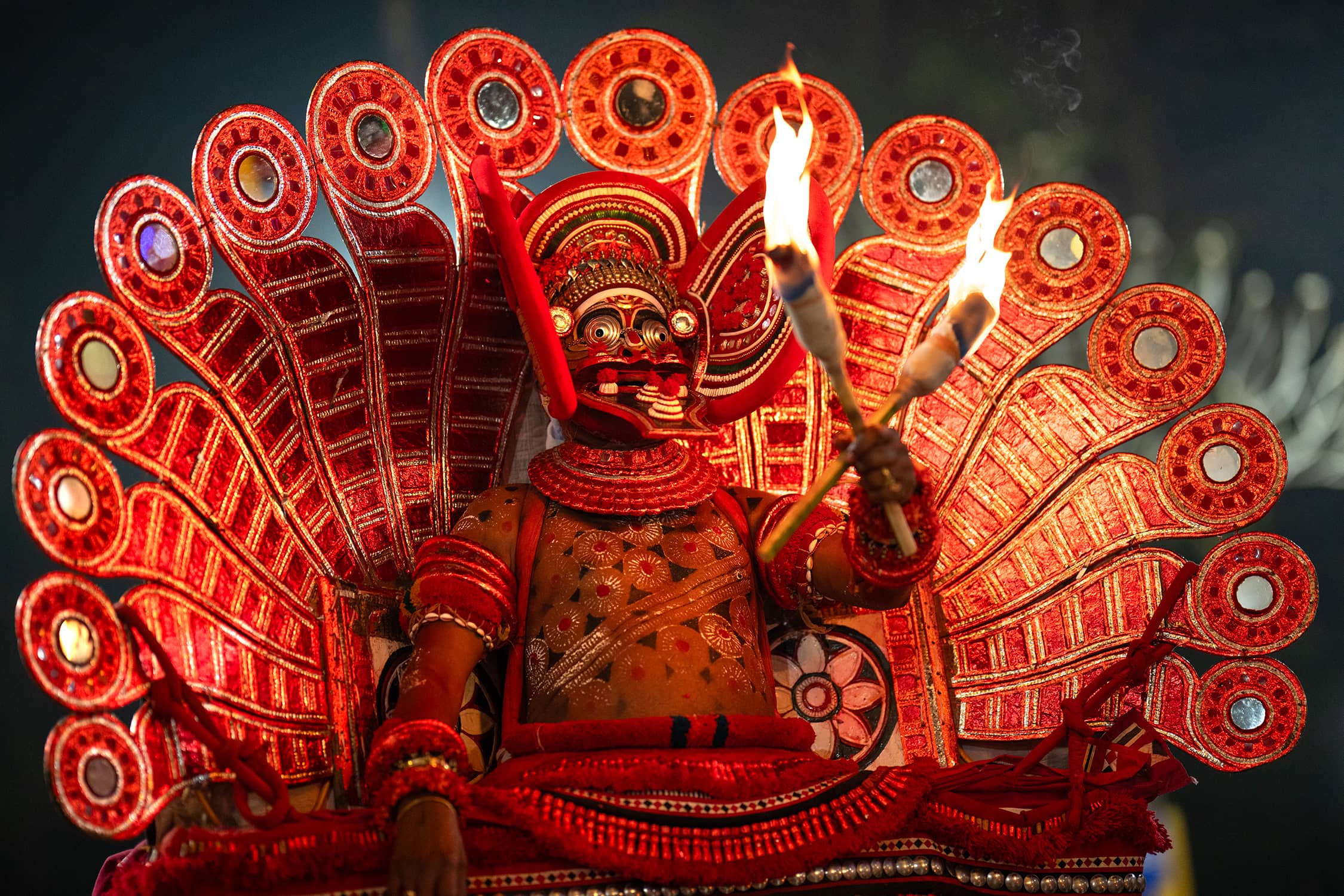
But the real anticipation was for what lay ahead. We had to leave at 12:30 am for the main performance, 'Kandanar Kelan Theyyam'. This was the moment I had travelled for. The fire! The intensity! The images I had seen and imagined for years were finally unfolding before me. We barely had a couple of hours to rest, but I don't think anyone really slept. There was too much excitement in the air. Around midnight, we set off on a 1.5-hour drive into what felt like the middle of nowhere. The roads got quieter, the surroundings darker, until we finally reached a temple deep inside the forest. It was pitch dark, except for a faint glow cutting through the trees that led us to the temple space.
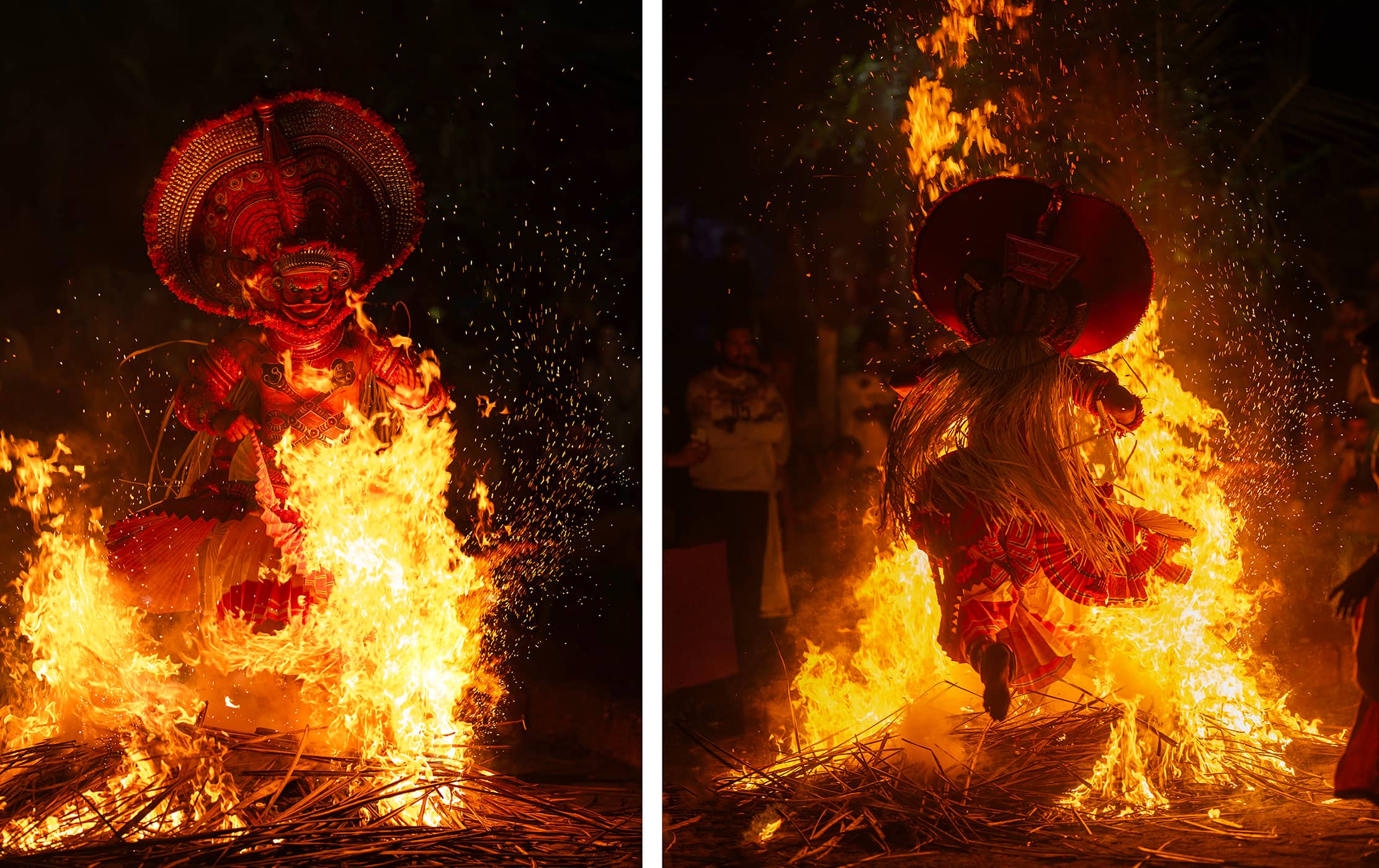
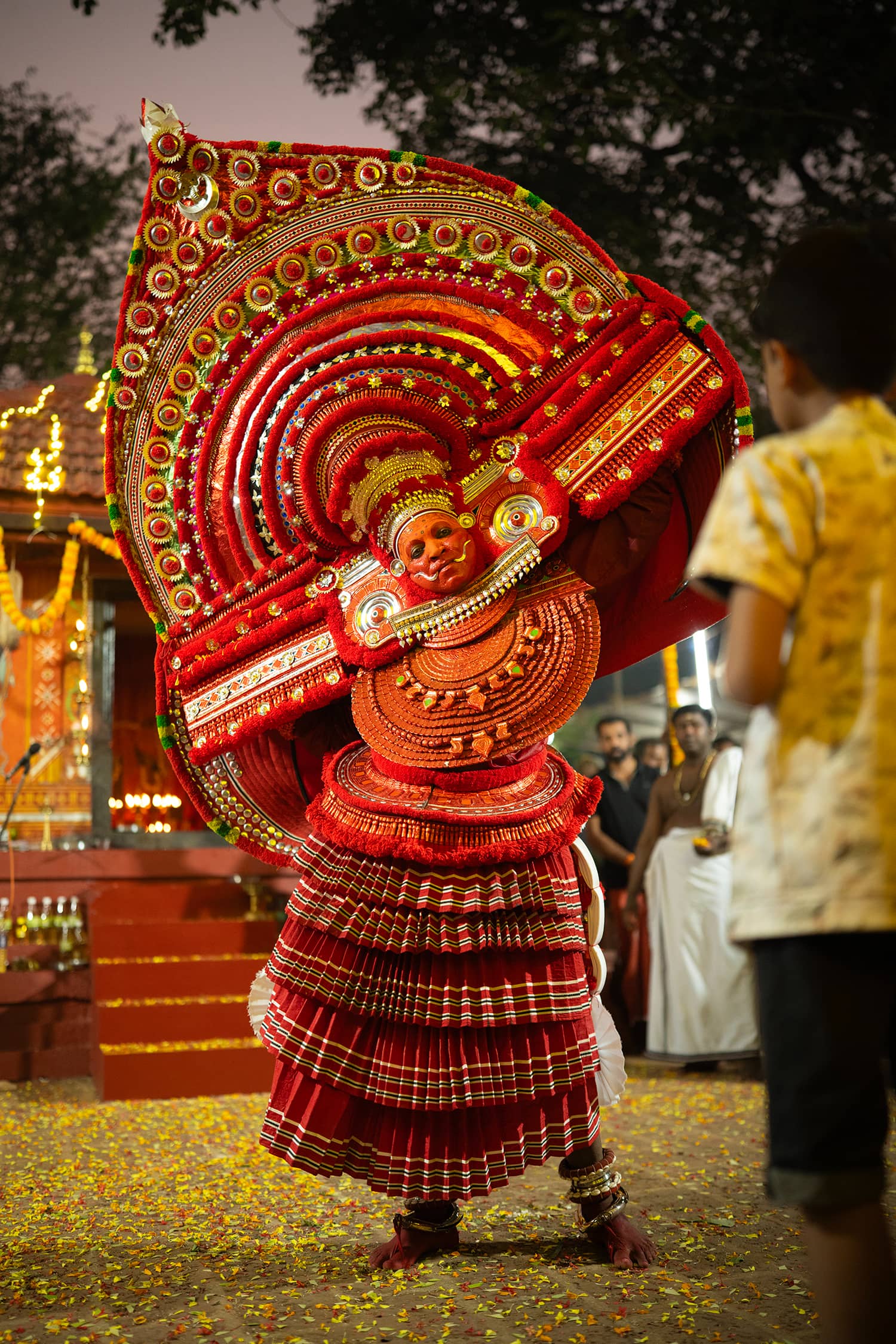
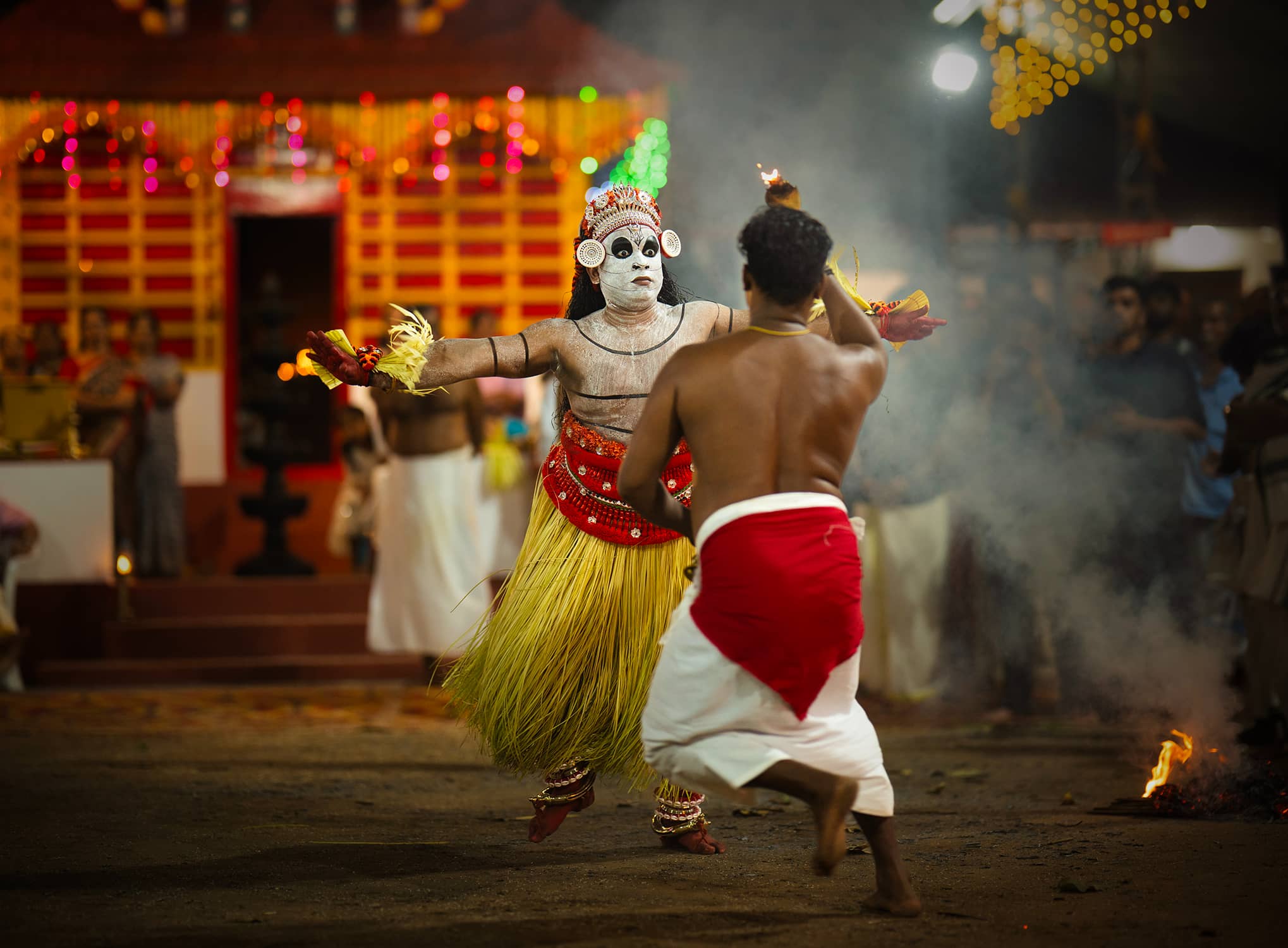
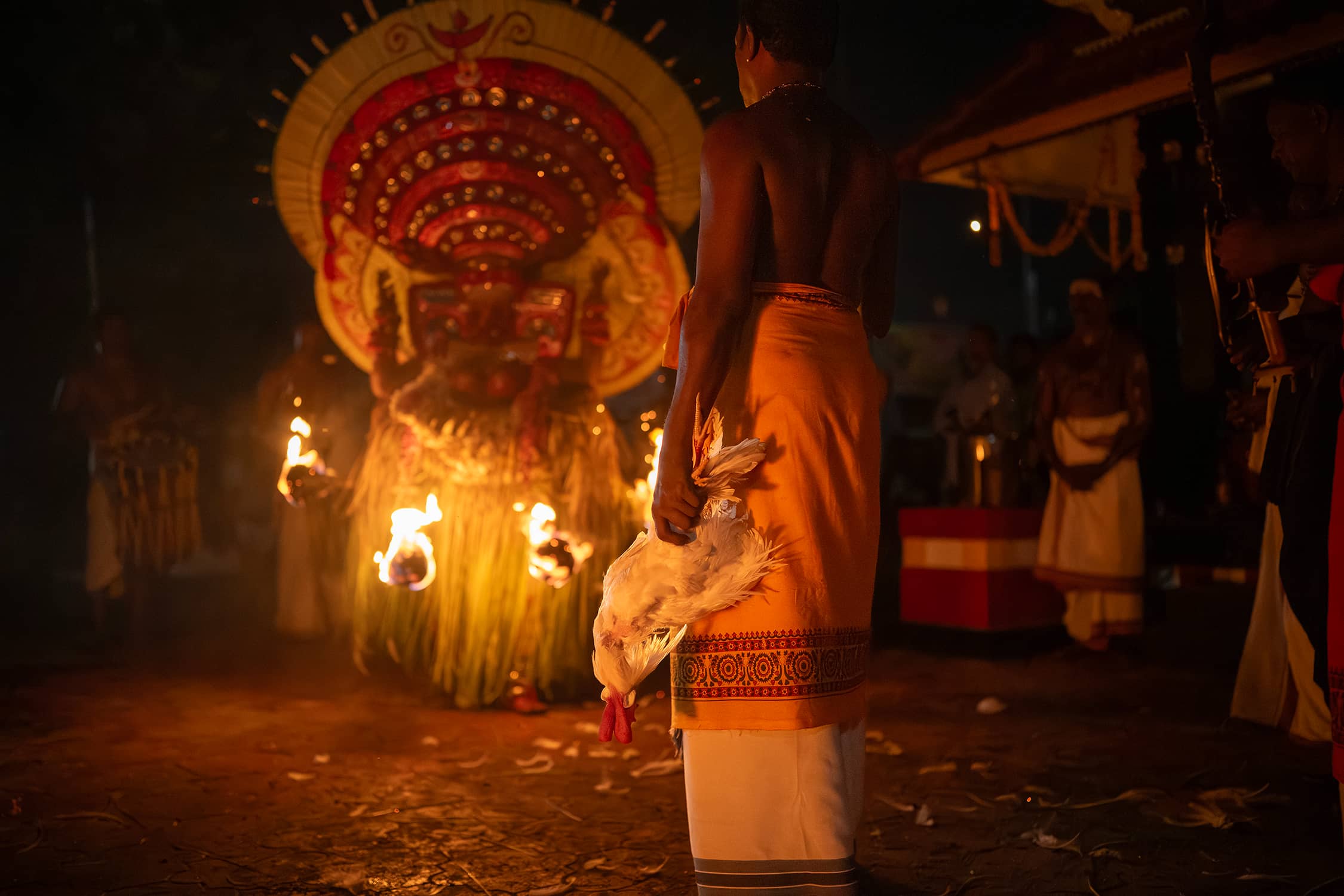
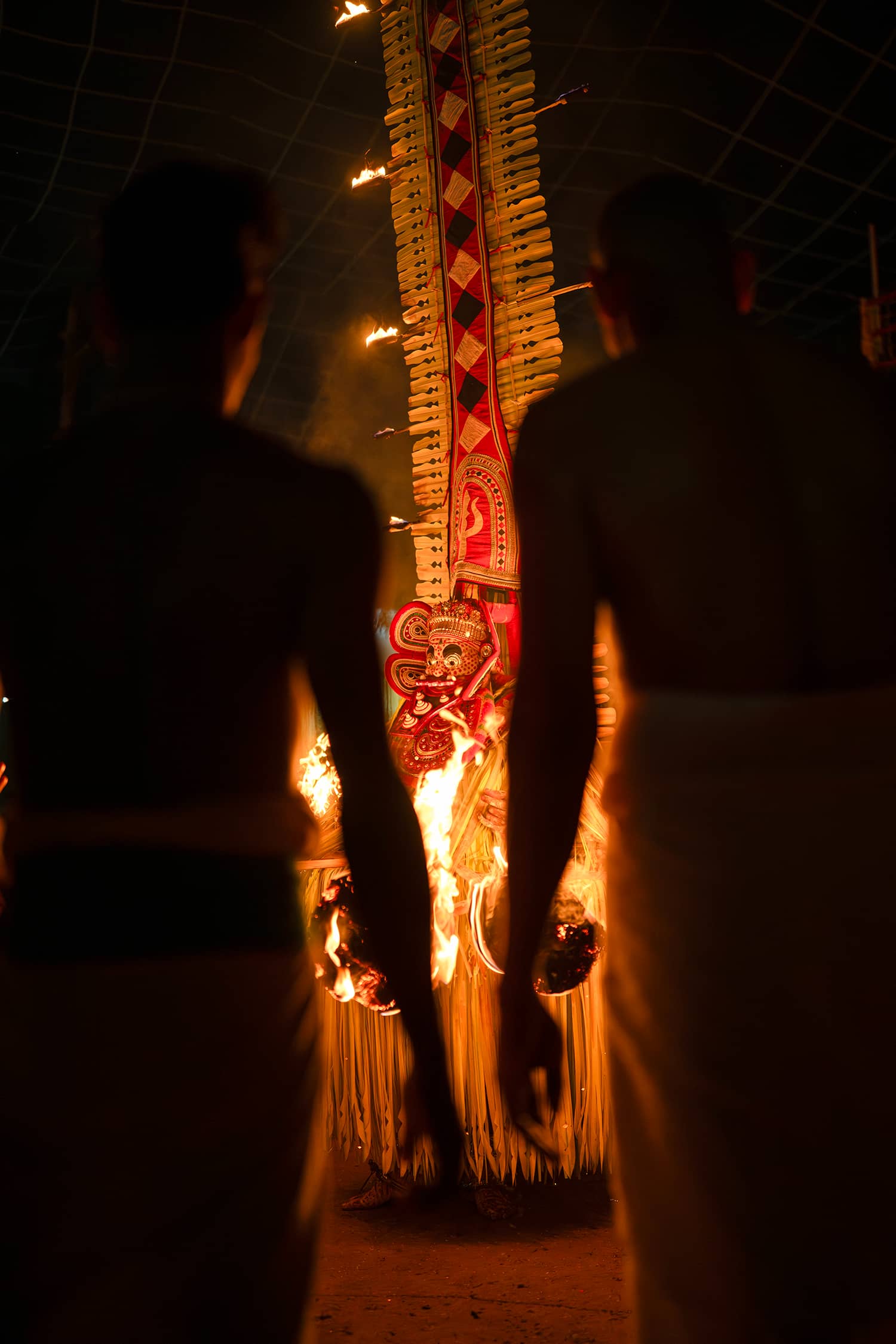
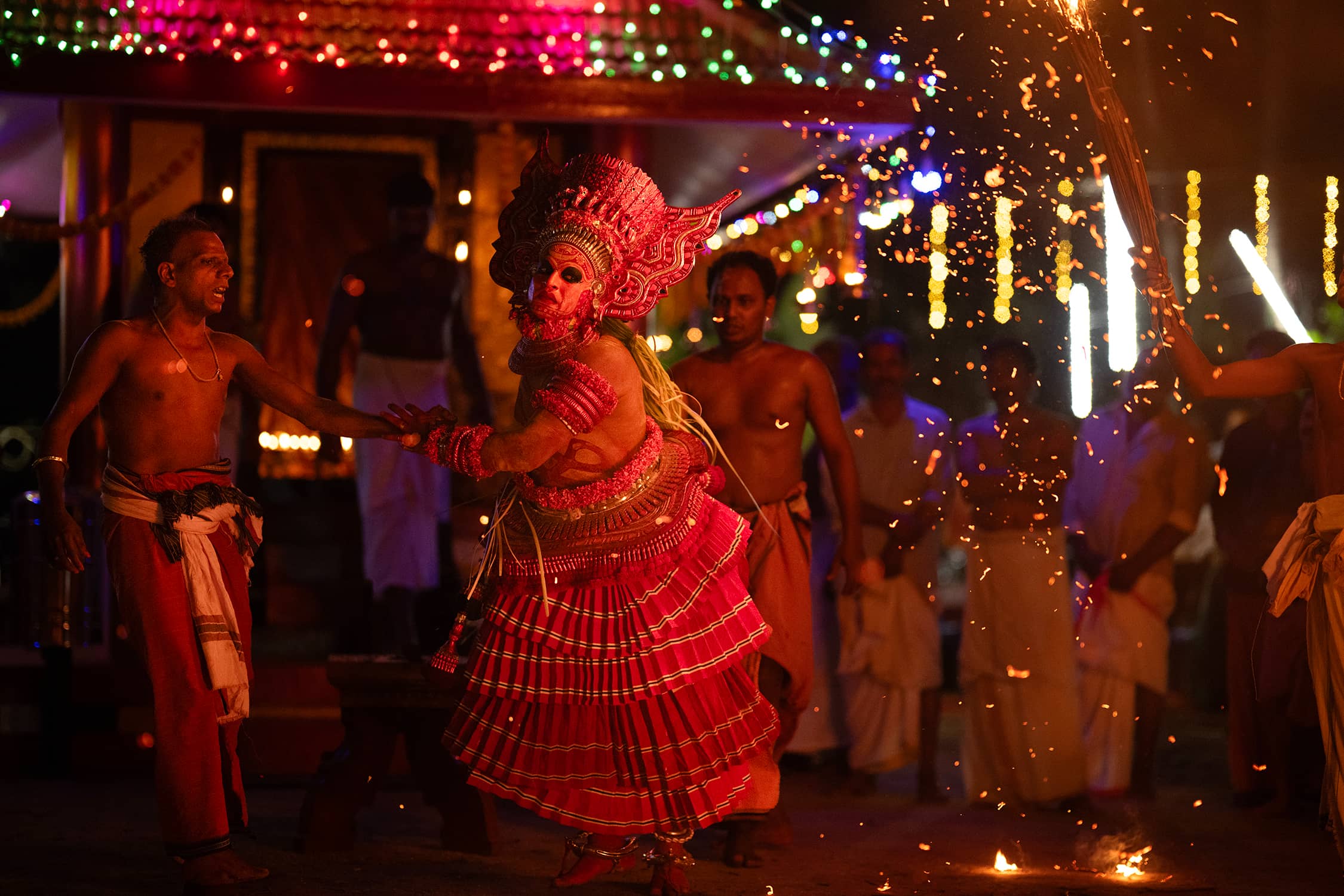
In one corner, a heap of coal was already burning. That sight alone was enough to make my heart race. After about an hour of waiting, the performer finally entered. There was no rush. He moved slowly, almost ceremonially, first seeking blessings, grounding himself. The drums began, steady at first and then gradually building, pulling everything into rhythm. And then… it happened. What followed over the next half hour felt unreal. Almost dreamlike. Piles of burning coal were laid out, layered with dried coconut leaves to intensify the flames. Priests kept feeding the fire, again and again, until it roared. And the performer, now completely in his element, ran through it. Jumped into it. Over and over. Sometimes alone, sometimes supported by two helpers, but always with this fierce, unstoppable energy. It didn't feel human anymore. Just fire, movement, rhythm and something far beyond all of it. Shooting in those conditions was a challenge I wasn't prepared for. The only light source was the fire itself, constantly shifting, flaring, fading. Focusing was tough. Exposure was unpredictable. I thought I got a shot at one point, but I kept clicking anyway. Because this wasn't something you pause.. This was something you stay with. And honestly, a part of me didn't want it to end at all..
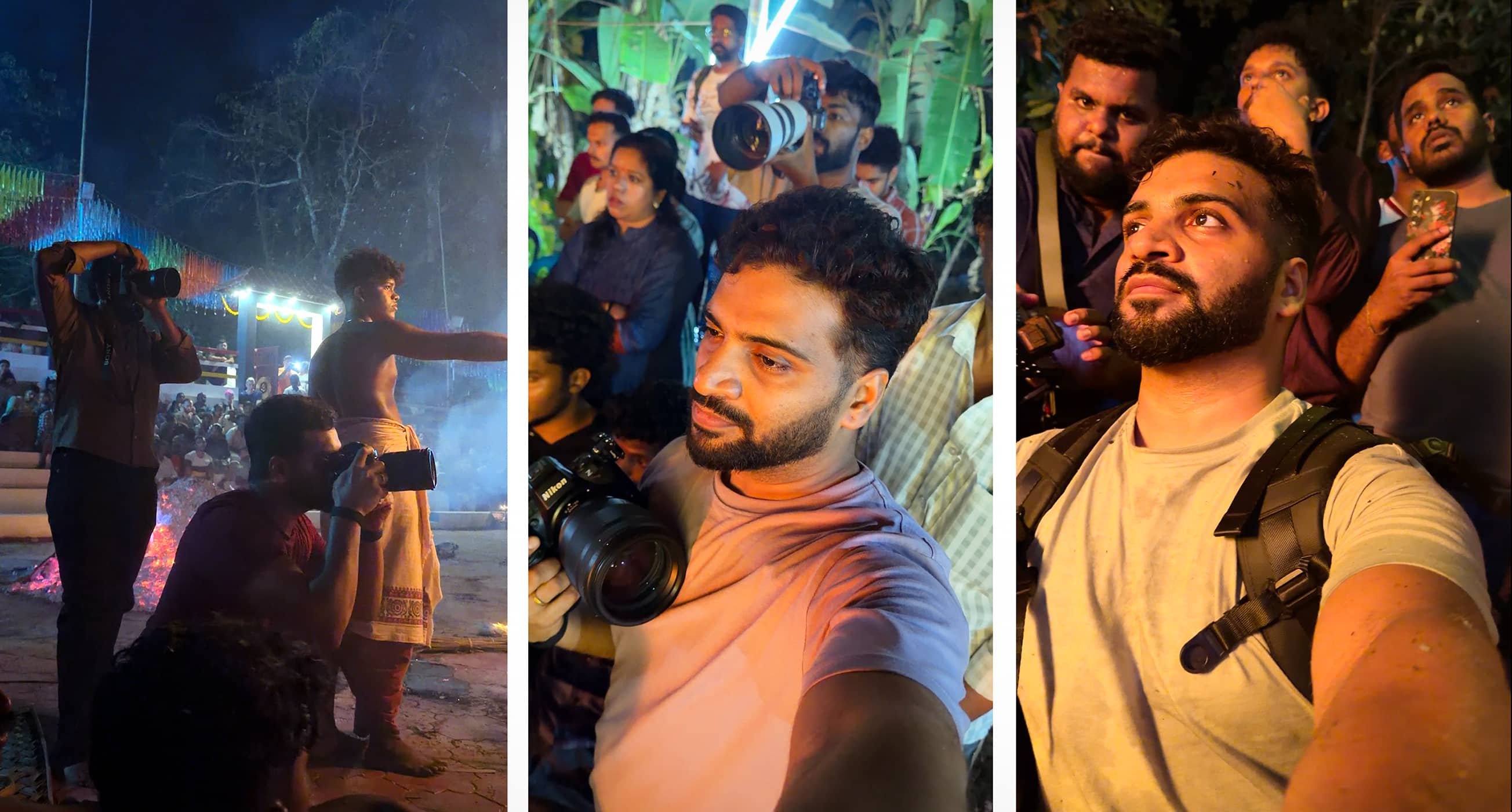
Shooting a Fire Theyyam at night is something else. You're right there, close to the performer, and the heat from the fire mixed with the heavy Malabar humidity feels like you're standing inside an oven. It's intense, almost suffocating at times. And when the performer gets completely lost in the act, sparks and tiny embers often fly your way- you don't just witness the fire, you actually feel it on your skin!
Going Solo
The next day's guided tour was meant for sightseeing. I went along with it, but if I'm being honest, my mind was elsewhere the whole time. I had already gotten a taste of Theyyam the previous night, and that's all I could think about. So I decided to do something a little impulsive. That night, I planned a solo trip to another temple, about an hour away from the base. I came across some information online, made a few calls to confirm, and sure enough, multiple fire Theyyam performances were lined up. That was all the validation I needed. I figured out my travel, packed my gear, and just went for it. And I'm so glad I did! The experience felt completely different this time. Perhaps because I was alone, or perhaps because I was more present, something about that night stayed with me in a very personal way. The locals were incredibly warm. I must've been asked "Have you eaten?" at least six times that night. It wasn't just a question, it felt like genuine concern. They could tell I wasn't from around, travelling solo with a camera, and they went out of their way to ensure I was okay. I ended up making a few friends there. They helped me figure out where to stand, where to sit, how to position myself to get the best view (and shots) of the performances. It didn't feel like I was alone anymore.
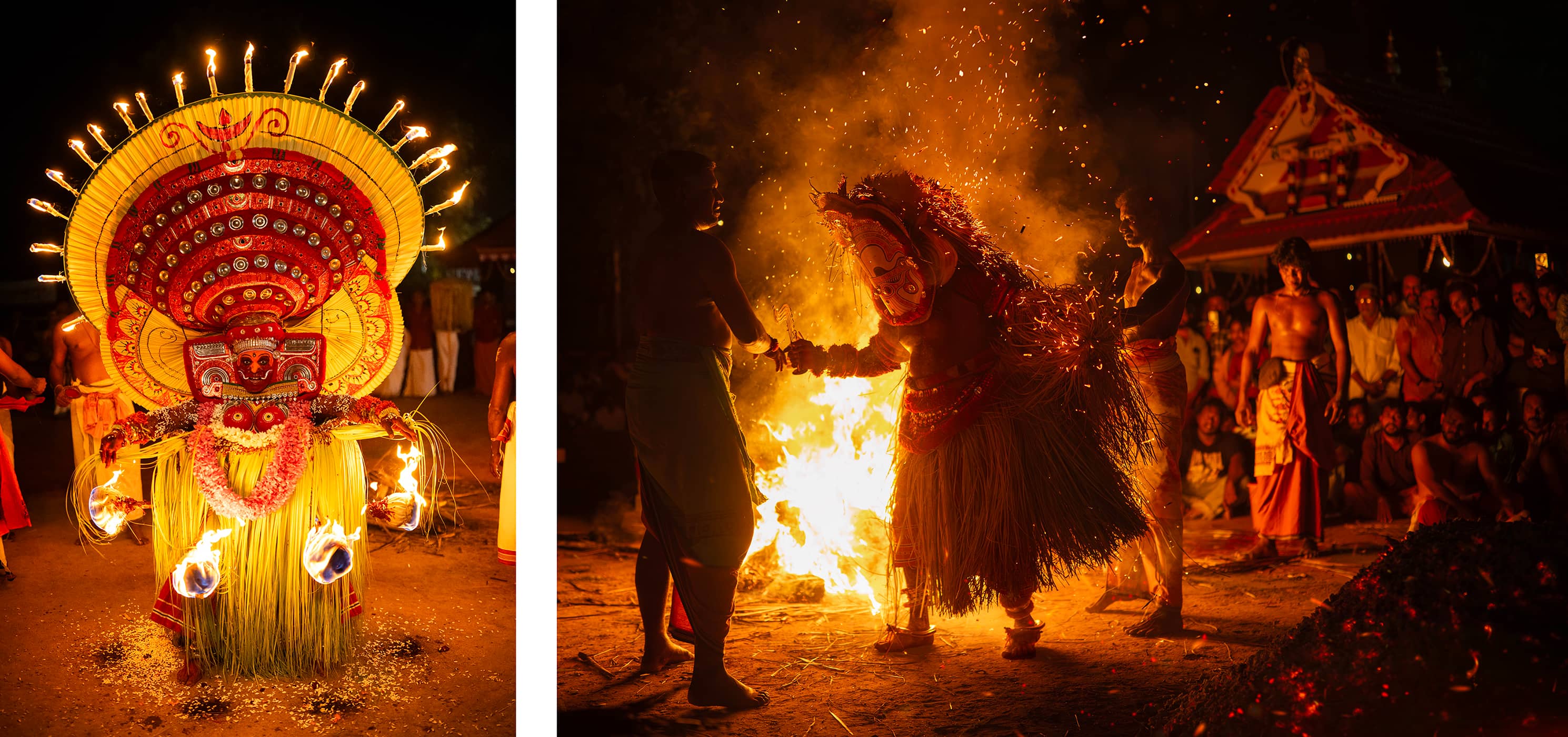
And then the performances began, one after another. The energy kept building through the night. Each Theyyam had its own presence, its own rhythm, its own story. I found myself completely immersed again, moving between observing and shooting, trying to take it all in without missing the moment. Time just… disappeared. Before I knew it, morning arrived. Around 7 am, I finally wrapped up and made my way back to the base- tired, slightly disoriented, but completely fulfilled. One thing I've realised through this: if you really want to experience Theyyam, sleep becomes secondary. You're constantly waiting, anticipating, chasing moments. And in between, you steal little naps wherever you can- sitting in a corner, surrounded by crowds, holding onto your camera like it's part of you..
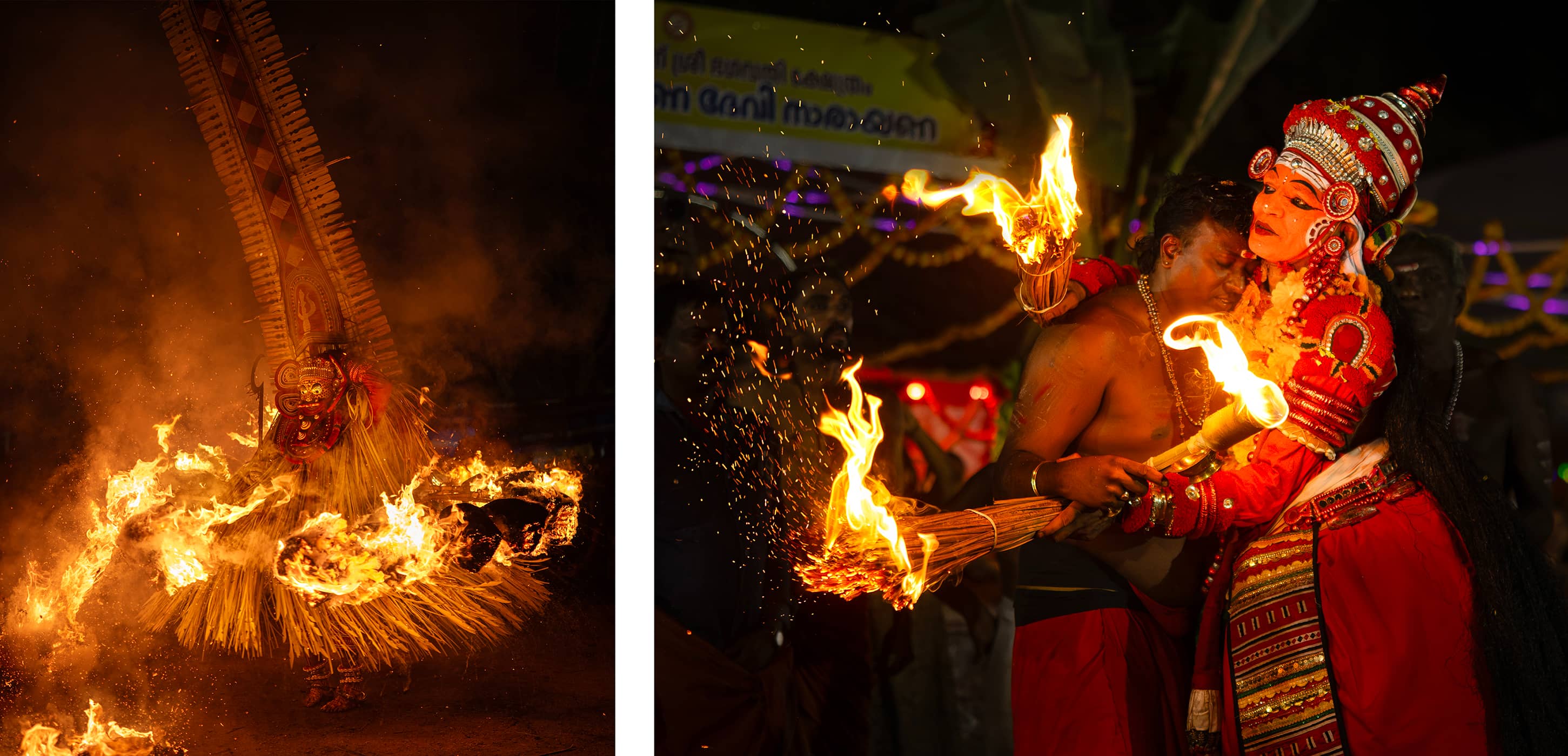
I still had one more night left in Kerala, and by then, I already knew how I wanted to spend it. After checking out from the Theyyam Tours homestay, I pretty much repeated the same plan: chasing another Theyyam, one more night, one more chance to soak it all in. That night blurred straight into the next morning. No sleep, just continuous movement- watching, shooting, waiting, absorbing. From there, I didn't even pause. I headed straight to the airport, carrying exhaustion in my body but a head full of moments I knew would stay with me for a long time. But the strange part? It didn't feel like enough. Within just ten days, I found myself booking another trip back to Kerala. There was still so much I hadn't seen, so many stories left to witness, so many frames left to capture. And something tells me… this isn't going to be a one-time thing. I know I'll be back again, maybe next season, maybe every season..!!